Vestibular repost

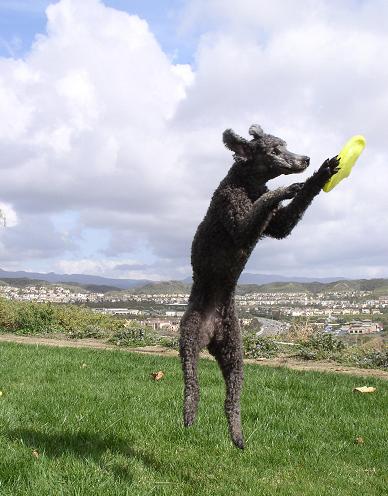
                                              My daugther and Tilley before the onset of Vestibular

I wanted to talk about Vestibular again.  It is such a common issue with dogs and yet something that is really unknown to most unless you've known someone who has experienced it or gone through it yourself.  Since Tilley's onset of Vestibular disease back on the 11th of January I've met several people who had the same thing happen to their dog.  The sad thing is that they had no idea what it was and to end their dog's suffering they had them put to sleep.  I want to tell as many people as I can about this horrible yet very short lived experience.  Of course all dogs are hit differently and all dogs will recover at a different rate, but they can recover. 

Now at 10 months after the onset of Peripheral Vestibular disease, Tilley is doing amazing.  She has good moments and some not so good moments.  The mornings are good and bad, good in that she is rested and has more spunk although it takes her quite a while to get her footing straight.  Going downstairs is about her worst activity, being that she lives in a perpetually crooked world.  Lowering her head makes matters worse but she does it and has only stumbled a couple of times.  She can run after her ball but has learned that she must slow down before trying to pick it up off the ground.  She took several spills, head over heels before realizing things had changed. 

She has an amazing appetite, can make it up onto both sofas and one lower human bed in the house.  Tilley is very happy and healthy other than her Vestibular and now a spine issue.  We are very careful how we roll her ball for her and try to avoid any spills that she may take.  She lives to retrieve so although we have cut way back but it is something we cannot take away from her.  Back several months ago she was completely paralysed in her two front legs.  The vet gave her a 50-50 chance of recovering and after many tears she showed her true colors and made a full recovery.  A shot of cortisone, pain meds and predisone and she was back at it.

Below are previous posts from when it first hit and pics at the bottom of Miss Tilley now at 13.5 with her residual effects of vestibular.  She has a slight head tilt to the left and her body then wants to go left.   She is also very unstable on her feet, that is until she sees a ball then somehow this old girl can fly.  Unfortunately it never goes away but it most definitely gets better.

Tilley's initial onset post.

Video of what it looked like in the beginning

18 days later, she turns a corner

What is Vestibular disease?

Taking liberties


Many people ask me if I've ever been bitten, my answer would have to be "not by a dog."  I have been involved with dogs for over 35 years, I started in the conformation ring, moved onto training, owned a pet walking service, been a professional dog trainer and dog photographer and the only thing that ever bit me was a duck of some sort.  Yep a duck, or it might have been a goose.  I was actually doing a photo shoot with a couple of very beautiful Belgian Tervurens, quite an intense breed.  The shoot was fabulous, the dogs were wonderful, it wall all good but the duck/goose.

We were shooting at a lake, a small man made type lake with tons of ducks and geese.   I was minding my own business, I would never harass a duck or goose and always keep my distance.  Well this one, let's call it a goose, this one grey goose was harassing me.  Not the dog, me.  It followed me everywhere, I kept moving out of it's way and it kept coming.  Finally when I was completely involved with the dog I was shooting it came up behind me and bit me in the lower back, right where my jeans and shirt left an opening.  I was shocked, I had a few choice words for this bird and we moved off far enough that I could keep it in my peripheral vision.


Other than that I've really only had a handful of diffusing situations.  The type of  moment when your dog reading skills need to be at their finest.  Three were training clients and two that I can remember were photo clients.  Quick thinking and very fast but slow and calm turn a ways solved each instance.   Each of the scenarios were caused by the dogs realization that I was in their space.  Only one actually barked at me, the others I avoided any vocalizing by moving quickly out of their space by simply and smoothly turning sideways.

One such incident was with a rescue Mastiff, we'd been getting on fine, not great but he was putting up with me.  He was standoffish enough to let me know that we were not friends.  All was fine until I moved in for a close-up and I crossed an invisible line, one that I knew I'd crossed by the change in facial expression and rise of his ears.  I snapped quickly to get a shot with his ears up and then turned away which immediately solved the issue.


We humans tend to be presumptuous, taking liberties with the canine species when we meet them.  So many people tell me how others move in on their dog even when they have been asked not to.  Some have to resort to holding out their hand to stop an interaction "no they don't like strangers," as the stranger persists.  "All dogs love me."   Very few dogs want you pawing all over them, they don't know you.   Dogs will clearly tell you that they don't want you in their space, are you listening?  Are you watching and reading their signals?  Dogs are great communicators.  Ducks?  I'm not that educated on duck behavior to be honest.  To this day I do not know if he loved me or hated me.

Out of sorts

We head out yesterday for our morning walk, things were different right from the start.  I head downstairs with Luke and Jessie at my heel.  I normally take the girls out together and then Luke.  With Tilley at 13.5 and Jessie 14.5 they are a good match, speed wise.  Luke needs more physical exercise so this was different taking slowpoke Jessie and speedy Luke out together.  The difference was instantaneous, both Luke and Jessie are dominant dogs, they have always butt heads, but mostly butt head Luke is the instigator.  One step out the door and he was wound, chomping at the bit and completely consumed by being out front.

Right away I ask for control, we are not moving forward before Luke get's a grip.  Jessie is in my arms, this is fueling his obnoxious behavior.  Asking for control is not easy for a reactive dog on a "top dog" mission in this state.  So with high pitch shrieking, spinning and a bark here are there, I waited.   I received lots of eye contact as he tried to get a grip, Jessie waited patiently in my arms.  Being nearly deaf and blind, being in my arms is a must.


As soon as Luke was able to achieve a sit we moved on and he was more calm.  It is essential to nip over excitement in the bud, it is much harder once they are in the zone.  The ride to the park was pretty normal until we got to getting out.  All of my dogs are trained to remain in the car until told otherwise, again very important.  I don't want dogs diving out of the car and endangering their lives.  Both Jessie and Luke wanted out first, Luke won this one as I assisted him out.   He waited patiently as I lifted the old gal out and hooked her up.  After that we were good; Luke looked back at me several times as we walked along.  He seemed to ask "what's up?"  We were walking slowly, really slowly.  But he got into the swing of our snail pace walk before too long.  For a boy who likes to speed walk, he did pretty darn good.    

How much is that doggy in the window?


Born in the bottom of a rusty cage, he made his way over the filth to eat.  There wasn’t much to suckle and what was there was a fight to find through the clumps of matted and foul smelling hair that he knew as his Mother.    She was a small unrecognizable girl, a Yorkshire terrier under the putrid hair that she had accumulated over the years of living in a mill.  She did her best to care for her puppies, even in these horrific conditions she was a good Mother, the best that she could be. 

He was only one, with his Mother barely hanging on she could only conceive but one, her little body knew her limits.  So it was only he that she had to care for but even one was a lot when no one is caring for you.   He managed to get just enough to grow, he was alive and that’s all that the millers cared about.  Thriving meant nothing here, you were either alive producing or on your way to make them money. 


It wasn’t long before the pup was opening his eyes, what lay before him was his life for a short time, hers for a lifetime.  She sat there in this cage for as long as she could remember, here in her hideous so-called life given to her by those who were her captors.   She had been purchased as a loving pet, her original owner duped by the one that had tossed her in a cage and left her to simply produce.  And now she was with pups yet again, just one this time and he would be with her long enough to see the despair and then be swept away in a box.

As the sun peaked over the disheveled building the frenzy of barking commenced, it was collection day.  Any puppy 4-5 weeks and over that wasn’t half dead was stuffed into the collection boxes and thrown onto the transport truck.   This was what it was all for, the fat check in return for the puppies.  The more puppies, the more money was to be had.  There were no long goodbyes, no sad faces watching their pride and joy move onto a new life, no this is simply a money making business fueled by greed.


The puppies arrive at their destinations across the country.  They are set into new cages, ones with big windows on one side so that the prospective buyers can pick and choose.    The retailers draw you in with the big windows in the front of the store, filled with happy, romping puppies in them.  You know that you cannot fight the force of an adorable puppy face and you just have a quick peek.  Just  looking.

It isn’t long until you are thinking, the sales associate is hovering,  they can spot a deal in the making.  Their sales pitch begins, they spew lies as they reel you in.  “No, we don’t buy from Puppy Mills, no we have a list of reputable breeders we buy from.”    Noticing the little puppy in the corner of the cage you ask “is there something wrong with this one?”  “Oh no, he’s just tired.”  With his head wobbling from the sheer weight of it he struggles to keep going.  From the filthy cage where his life began to this brand new pink and purple one where again, there is no one who cares, really cares.

So you are duped into buying the little fella, the impulse purchase.  Impulse and the AWWWW factor is what these stores rely on.  And the employee agrees as he pushes, he’s so small and seems like he needs you.  You take him home where you expect him to fill your home with puppy happiness.  But he won’t eat, he cannot hold his head up and he isn’t waking up.  After a day of not eating you rush him to the vet where they take drastic measures to try to save his life.  Finally with people who really care it is too late.  The Dr. and techs are rushing to save him, but with all of their attempts his tiny life slips away, he never stood a chance. 

This is a fictitious story that I wrote as I considered all the folks that will be wandering into the pet stores this Holiday Season.  Although these dogs are not real, it is a very real story played out everyday across the country.  Please, as you pass by a store that sells puppies, think of the ones left behind in the filth and horror, take a stand.  

Mani Pedi time

 
 This is my girl Jessie's foot, just so you know it was an image request shot from a dog magazine.  I do not paint my dog's nails, just wanted to clear that up.  :)


Nails, almost everyone I talk to are mystified and petrified about nails, dog nails that is.  Many people like to just ignore nails entirely.  Do you have to cut your dogs nails?  Have them cut by the vet or the groomer?  Most dogs these days need assistance in shortening their nails, they don't get out hiking enough to wear them down naturally.  Although there are dogs that will never need their nails clipped until they are well into their senior years.

Several different elements factor into nail wear and tear.   Where you take your dog for walks, what is the surface that your dog typically walks on?  Are they usually walking or running in a field?  Or do you walk them down the street and paths where they are striding along on pavement?  Next is your dog's physical structure, their gate is a large factor in the natural grinding effect.  Dogs naturally wear nails down more when they are running around, so if you have a slow saunter type pooch, chances are their nails need some attention.


So perhaps it is mani pedi time, yes?  If you are squeamish about the whole process, your veterinarian or groomer will be happy to oblige.  But I must say it is easy to do yourself.  I use to use clipper type nail trimmers but have since switched to a dremel tool.  After many years of clipping, my little gal Jessie decided that she really hated having her nails cut.  I took this as my cue for change, I bought my first dremel and now my maintenance process has been altered.  Both methods are simple, the dremel is a tad less scary when contemplating hitting the quick.  The quick is the tender tissue part beneath the surface of the nail.  Not seen in a black nail, but you can see it if your dog has clear nails.  Once you start cutting or grinding nails it becomes a very easy process, you simply take off the point that grows quickly from week to week.  

Nails should just touch the floor, they should not lift the foot at all.  When standing still the dogs nails can clear the floor or just touching which is the proper length.  Left too long they can alter the way a dog walks.  Many dogs never grind their nails down naturally and they continue to grow until they cause pain.  

When starting out, take your time; use lots of treats and start with baby steps.  Never hold your dog down to cut their nails, this only causes them to panic and prove to them that it is horrible having your nails cut.  It should be a positive activity, if that means one nail per day then that is how you start.  Lots of treats and patience.  

Studio photography


I've often toyed with the idea of moving into a studio with my photography.  The people and dogs coming to me?  That's a great idea, that would make my shoots a breeze?  My shoot days consist of quite a bit of driving; hauling my camera bag and other equipment which weighs a ton into my xterra, my poor back and shoulders.  I face the wonderful Southern California traffic; drive turtle speed down the destination road trying to locate the particular house and then hoist my equipment once again.  In the house I do my canine greeting first, as the dog is normally the first one in my face, unless of course they are the shy type, then I really have my work cut out for me.   I say hi to the owner and get back on the floor to get to  know my subject a little bit more.

Once I feel that I know who I'm shooting we move onto the a tour of the house, yard or park as I scan for those perfect spots to shoot.  The entire time I'm asking what my model likes to do, where is their favorite chair, do they know how to stay?  These are all important, I want to get a good shot, one that best portrays the dog as their owner knows them.  Once I find a few great spots to shoot I set up my camera.  My camera bag is a backpack type, being that many of my shoots are at the beach or a park, wheels wouldn't work so well.  So, my camera is set up and we are set to shoot.


Depending on how the dog feels about being starred at by a giant black eye let's me know if I need to switch to my big zoom lens or not.  Many dogs are not comfortable with me all up in their face which means I won't be getting a great shot until I move away.  So I switch out the lens and start again.  The dog starts to relax but keeps an eye on me, I start to get some great shots.  Then I start my happy talk; we're just warming up (oh at this point the owner is usually laughing at me.)  But the important thing is that the dog is happy and relax, I'm shooting away.

My shoots are easy, fun and relaxed, the way that they should be.  The dog is asked to lay on their favorite sofa, bed and owners bed for the shoot.  Then asked to go out and play a bit, perhaps roll around in the shade, sounds rough eh?  All this in an attempt to get "the shot."  For me the shot may not be what the owner thinks "the shot" is so there are literally hundreds taken. 


But it never fails, it is almost always one of the last shots that is "the" shot.  It makes sense, we've spent at least an hour together and the dog is nice and relaxed with my presence.  If we are in a park surrounding, the dogs ya ya's are just about gone.  Many times it's been the very last shot, although sometimes it is the very first, right out of the shoot shot that is "the" one. 


I was recently looking at some shots of dogs in a studio, imagine how easy it would be, dog on the table, camera on a tripod.  But the dogs face was not relaxed, the dog was not relaxed, the dog was not going to offer "the shot."  I'll stick to dealing with the traffic, hauling my equipment, crawling around yards, dirt, sand, parks and homes and keep doting on my models.  After all it is all about them.  It's my job to get the shot, and I love it.


"He's friendly, look he's wagging his tail."


In my peripheral vision I see blanket movement, I glance over to witness more motion, it is Luke's tail, he is dreaming.  Whatever he is dreaming about he is wagging, but a wagging tail does not always mean happy or a good thing.   I remember several years ago when I was out walking on a beach alone when a stray dog came out charging.  It stopped about 20 feet away barking menacingly, growling and wagging just the very tip of his tail which was curled well over his back.  Hmmm, charming.

I have to admit I love a dog that is a real wagger.  That said, there is a reason why I like a wagging tail, and that is because it makes reading the dog much easier.  Reading a dog is a whole package process but the tail is a huge part, if they use their tail a lot.  Some dogs like my Tilley girl are not big waggers and if she is not super happy then it just sort of hangs there and doesn't say much.  And tails can have a lot to say.


When you read a tail there are many things to watch for, position, speed, tension and the rest of the body.  For some dogs like my Luke, they hold their tail naturally high.  He is a fairly dominant but friendly boy, the only time it freezes in its upright position is when he is making a point.  It is essential to look at the tension of a wag.  The tail could be wagging loosely like a flag in the breeze or very taught and fast.  Loose is good; the more relaxed a dog is the more flag like their tail will be.

This is one of the reasons that I am very against docking tails.  Dogs communicate hugely with each other with their tail and to chop it off handicaps them to a degree.  The following link is to an article written with regard to research done in British Columbia, Canada on length of tail and intra-species communications.  It is a long read but extremely interesting.

Behavior response to different tail lengths

A wagging tail can be very deceptive, first decipher what the tail is saying, then look at the rest of the communication being delivered via the entire body.  Many people have been bitten to their shock by a dog wagging their tail.

Trust


As I reach down for my little one, a towel draped across my arm I see the telltale signs of stress in my boy's eyes.  He's not the one I'm reaching for, no I'm reaching for Jessie but Luke knows where we are going and is stressing that he is next in line.  He honestly never misses a beat.  No, he does not enjoy a bath time, at least not at the beginning although he does seem to realize just how wonderful a warm water massage is by mid scrub.

As I call the dogs outside, I have a flashlight in hand and the concern starts.  "Oh, oh, Mom's doing something to us."  Although they are slightly concerned as to what it might be that I will be doing, one by one they come and lay by my side and await the procedure.  They trust me immensely, I have never, ever given them cause to not trust me.  Even my nervous Luke with his heavy breathing stress will lay quiet and let me "see."  I have taught him that "see" means I must look at something on his body.  This, so that he is never left not knowing what is going on.


Trust is huge with dogs, and this is why you must be trust worthy from the get go.  Boy, let one thing happen and a dog does not forget easily.  Sure over time an incident may fade but it can take forever to undo something that accidentally was ingrained.   I have never had to be quite as careful with any other of my dogs as far as my actions as I am with Luke.  You see Luke is a watcher and worrier, while my girls are both extremely intelligent, Luke just seems to have an extra something, like perception.  He reads me like a book and the slightest wrong body posture can send him into a state of unnecessary worry.

Building trust can take some time, of course there are dogs like people who trust everyone and every approach.  Repetition of the positive is the only way to build trust, and the more nervous a dog is the longer it takes.  If a dog has had a past of broken trust as many true rescue dogs have it may take years to regain a real solid trust.  Dogs in general are much more trusting than we humans aren't they?  They put their complete trust in us to take care of them to the best of our ability, and that doesn't always pan out for them but yet they are willing to try again.


But even dogs who have been betrayed by a human in the worst way possible, abandonment, abuse or malice can and do trust again.

Luke came to us as a young puppy; he is a naturally nervous dog.  As I pull him down to me so that I can  give him his weekly physical, teeth scraping or ear cleaning I explain to him what I am planning.  His nervous breathing slows, our eyes meet and we have an understanding.  I feel his body relax as he puts his complete faith in the fact that he trusts me unconditionally.  That my fellow dog lovers, is what it is all about.

Revisiting conventional vs. positive reinforcement


Some topics need revisiting over and over again.  This of course stems from the fact that I see the behavior repeated again and again when I am out with my dogs.  Today I was dropping my hubby off at  his car, we had met up at the park, he runs Luke and I do the old lady saunter.  As I pulled up to the curb I saw a woman walking three dogs, I see her often.  Her dogs were going off on a couple of other dogs that were walking past, she reached out the back and kicked one (Caesar style.)  My husband asked if I'd seen it and then asked why would she do that?  We then got into a big discussion; conventional vs. positive. 

First another quick story, I was shopping for furniture one day with my daughter and after spotting several items that I wanted I gave the sales lady who asked for my number one of my business cards. She thought it was cool that I was a dog photographer and told me about her young female labrador. She said that she was in the throws of finding a trainer and that she had attended a private class with one trainer already and wasn't sure she wanted to return. She told me about the trainer yanking on her dogs collar and becoming so aggressive with her young labrador that the young and very intimidated dog had squatted and urinated during the class.


She asked me if this was normal and I know she noticed me cringing as she finished her question. By the look on her face she knew my answer before I opened my mouth. My heart truly hurts when I hear stories like this, imagine the poor little lab in the hands of this brute? A client of mine several years back was told that she and her husband were going to ruin their dog which was a beautiful and gentle Golden retriever puppy. They were talked into leaving the dog for training and were not allowed to visit. When they did come to pick up their dog they found and underweight, emotionless shell of what they use to know as their bouncy and happy go lucky golden puppy, that's when I got the call.

I've been a dog trainer for a longtime. I was training dogs at the age of 13.  But way, way back then there was only conventional training. When I say conventional I mean the type with a choke collar, if the dog does not do what you ask you give them a quick yank on the leash to smarten them up. And the longer the disobedience goes on the harsher the yanks get which brews anger in the "trainer."

Amazingly enough to me there are still conventional trainers out there. With all the information written in magazines, newspapers and the internet about Positive inforcement training there are still the old collar yanking ones not willing to change their ways. I was introduced to positive reinforcement training  over 15 years ago. When I found out about it I felt like "why didin't I know about this sooner?" For the longest time I felt so guilty about the things I had done in the past but I finally had to let it go.

The years of conventional training I now look back on give me a better understanding of why I hate it and why I train the way I do. I am not a person who only knows one way, no I have been there and understand the difference big time. I think the biggest difference in conventional and positive is the emotion it creates. I remember being in the old classes where anyone who's dog was not performing properly slowly became angry at their dog. I watch people who rely on collar yanking now and see the anger in their reaction to non compliance.

This is where the conversation with my husband went, anger.  You could see the anger in the woman as kicked her dog and yanked it around trying to stop it from misbehaving.  It is far more than one way or the other; both methods of training come from a core idea and from that idea a person evolves.  

Positive reinforcement takes more patience and definitely a whole lot more thinking. I had a trainer friend of mine who was just learning about positive reinforcement tell me that she loved the way I thought things through when we were discussing a behavior issue. No two dogs are exactly alike and many times I would get a strange and new reaction behavior from a clients dog. I would then say "hold on, I need to figure this out." Why was this dog acting this way to a common behavior that I used on a regular basis, what was the difference here?

Dogs can do strange things and if you watch long enough and hear the guardian's explanation of background behavior it can almost always be explained. Not that the explanation always helps, sometimes you just need to move on from the cause to the solution. Often a behavior can be quickly solved by one tiny step from a guardian. I love dog behavior, I could honestly watch canines interact with other canines or with people for hours. I love the new guardians who have opted for using positive reinforcement, it has created a whole new breed of caregivers. Far from the yank and choke when a dog misbehaves, positive trainers search for way to optimize the possibility of good behavior repetition.  And that my friends is great news for all dogs.

Consider this


I am always surfing the web; I like to see who is having puppies and who are some up and coming GREAT breeders. While I am on my quest to find the "good" ones I inevitably come across the bad. And when I talk about the bad breeders; there is no one "bad breeder" mold. Of course there are the big ones; the millers, the ones who are the focus of many tv investigations. I've talked about this often but it seems you can never say enough; if I reach just one new reader each time I read I will be happy.

I remember a while back having a heated conversation with a group of dog people. I had called a certain breeder; a miller, in my opinion they fit all the criteria. And that is my criteria. I caught a lot of heat for tagging this breeder as a miller; no I don't care, I call it like I see it. It is a huge facility; dogs are bred in cages, whelped in cages, puppies are raised in cages and then shipped to you. You can pick your puppy from an image on the puppy page then pay with paypal THIS IS A WARNING SIGN.


This is one of the major contributors of pet overpopulation. The big assembly line breeders are pumping out puppies by the bucket full. Just the other day I ended up on another breeder site; I was appauled at what I found. This couple had decided to go into the dog breeding business; they had no idea of what they were doing which was obvious by the lack of health testing and knowledge on their website. Another I visited just yesterday had puppies available from litters that arrived Nov 16, Nov 17, Nov 23, Dec 12 and it just kept going. THIS IS A WARNING SIGN!!!!!!!

The economy is bad right now; and many of these big bad breeders are still pumping them out. And they are running clearance sales; yep puppies half price "today only." THIS IS A WARNING SIGN!!!!!!!!!!!!!!!!! Think any of these puppies had early stimulation or socialization? Think any of them have been snuggled and loved by the people who are pumping them out? Think again. This is business and only business; there is no heart in what they are doing; money is what drives these businesses and it is a sad business indeed.

There is a saying that has been around for years; there is no money in breeding dogs. I agree; if this statement is coming from what I would consider to be a good, ethical breeder. They spend money on health testing, over the top nutrition and medical care, temperament testing etc. Sure they are paid for their pups as they should be; there is a lot of hard work that goes into breeding and raising great puppies for you, the future puppy buyer. But those who pump out puppies; the people who breed their dogs at every season, sell their puppies online, have 10 or more breeding bitches at a time, supply the pet stores and sell to anyone who has the money; these breeders make money. They make money because it is a business; a cold hearted business.

Where do dogs belong? I can tell you that they do not belong in a cage; they do not belong in a breeding facility (if you prefer that term). But to me; not all millers are filthy facilities, many are clean, efficiently run businesses. But dogs ARE NOT a business. They are living, breathing creatures who deserve a whole lot better from the humans they have ended up with. It breaks my heart when I see how these dogs are treated; no one cares about them, the only care they get is to make sure they continue to pump out the goods.

And the puppies that these people are pumping out are not healthy and happy; these people don't spend their cash on making sure that you; the future puppy owner gets a healthy happy product. Oh it will be cute; on that you can be sure, they know how this business works. Although one site I was on didn't even take the time to wash the mud off the puppies for their "look how cute we are" pictures.

So when you stumble upon a website; one with adorable puppies set up in the cutest of poses. They probably have a teddy bear or flowers beside them; and they've even been given a name. When you scroll down and see puppy after puppy; when all you need to do is to email these people, go to the paypal page and purchase your puppy DON'T DO IT. If you give these people your money; you are helping to keep these people in business. The Mom and Dad who linger; the dogs left in cages with no one to hug them, no one to walk them, no one to climb into bed with; there is none of that for the ones left behind in the cages. When they fall ill; there is no one to care for them, no one to lay their head on until they get well again. They are often dumped, discarded or worse. Afterall they are no longer useful; they have no money making abilities once they are ill.


And after their puppy producing days are done; then what? Do they spend their golden years on a fluffy bed by a fire, cared for by their loving guardian? No; they too are cast aside; often dumped at a shelter. But if they are one of the lucky ones; they will be adopted by a loving family who will then give them the life that they deserve but have never known. It is truly mind boggling how many of these places there are; do your research.

Please pass this on to anyone who loves dogs; perhaps it will make it's way to one, just one who doesn't already know this. If you are that one; find a breeder who has a litter of puppies in their bedroom or living room. A breeder who has all the health testing done so that you; the next generation gets a healthy happy puppy. If you've found a good breeder; it should be difficult to get one of their puppies, they only want the best for their dogs and puppies. And that puppy has received everything that they deserve; including a healthy and very happy Mom.

Dogs deserve our best; you can make a difference.

Not house trained


UTD on all shots; likes other dogs, cats and kids, may or may not be house trained.  Ooooh; that one might just sink the deal right?  Many second hand dogs are not house trained, there are several reasons why they may not be house trained yet.

1.  The first owners never bothered to train the dog.
2.  The dog lived in a cage, they just eliminated in their cage.
3.  Some dogs regress when they are placed into a new home.
4.  Often dominant dogs mark new areas, they may have been house trained in their first home but now everything needs marking.

So whatever the reason is that the dog you are interested in is not house trained, there is good news.  House training is not one of the difficult issues.  Some catch on quicker than others but most can be trained up with some serious structure, consistency, patience, praise and reward.


First line of defense is supervision, I'm a supervision nut.  If you don't have your eyes on your dog, how do you know what they are doing?  And how can you educate them if you don't know where and what they are doing?  You can't, bottom line.  So basically you are going back to kindergarten, you have to start back at the very beginning.  Even if you have acquired an adult dog you must consider the fact that they do not know that they should not eliminate in your house.

So, this means that you must supervise your dog at all times.  If you do not have your eyes on your dog then they need to be in an expen, crate, small room where they will not pee or poop or leashed to you as you move about.  The important thing to get started is lowering the chance of an accident in the from the get go.  The more positive reinforcement you get under your belt before you have to deliver a negative the better.  You are going to go back to treating your dog for going outside, it is a huge deal if they go outside, that is one less stain on the carpet.  Make sure that they get the treat as soon as they are done, don't wait to come in the house to treat them.  You go out and wait until they finish.

With all of this supervision you will see if they are going to go in the house; when they do let natural reaction lead the way.  We naturally yell NOOOOOOOOOOO when we see a dog peeing or pooping on the floor, keep it short and intense.  You deliver the message and then stop, calmly take the dog outside and wait for them to finish out there.  No grudges, no prolong nagging, an initial AHHHH and that's it.  You do not want to scare your dog but you do want get your message across, it is not acceptable to go to the bathroom in the house.   With many repetitive treat deliveries for going outside the house training will be well under way.  But you must keep it up, do not think you are out of the woods too soon.  Best to keep treating for going outside, it's much preferable over cleaning the carpet, no?

If you fail in supervising and your dog goes in the house; smack yourself in the head, you failed.   Calmly put your dog outside and clean up the mess.  Every time you don't supervise, you miss your chance to educate, you failed not your dog.

The hunter


I have often written about Luke's lack of desire to eat; it is at times frustrating and not something I look forward to in any of my future dogs. Feeding a dog who eats well is a joy as is feeding a big strong growing boy. I like feeding people and dogs who like to eat; I guess I fall into the Mom category for enjoying to feed for sure. But Luke has given me pause to think about the whole "I don't want to eat" issue. What is it in Luke that makes him like this?

There are times I have put raw meat in his dish and he walks away. He won't look to see what's in the bowl and he turns and leaves the room.  What I am finding and you will no doubt be laughing when you read this is that if I take his food and entice him with it; he will eat. So this leaves me to ponder. Lately I have been making him work for his food; taking a piece of meat and keeping it at a distance, winging it around like the proverbial airplane so to speak. Mmmmmmmm look at this, looks good eh? Giving him a little nibble but making him really want it by keeping it away for a bit*. This is really working, the more I keep it away the more he wants it. When I do give it to him he must pull it away from me which seems to trigger his prey drive, interesting.


So is Luke's low level food desire a problem caused by humans? Caused by the simple fact that we have over the years made eating out of a bowl the way we feed our dogs? Eating out of a bowl is a very unnatural thing for a dog; normal now after years of being fed in a bowl but genetically it is radically different from hunting down and ripping into their meal like a wolf would. Luke seems to eat just fine if his prey drive is tapped into.  For us it is quite normal to sit down at the table and eat our food very civilized like; for dogs not so much.

Luke is a different dog; he is like the "big book of dogs" for me and has taught me much over the years. He is reactive and very instinctive although many onlookers would think not so. There is clearly a wolf very near the surface of his poodle exterior. More often than not we humanize our dogs; I try very hard not to do this myself but as a human it happens and luckily for us many of our dogs have adjusted to our weird and strange human ways.


But we can help those dogs who have grown bored with bowl eating.  This morning I took their food outside, they were out there drying in the sun from their baths.  So I tossed their food around the yard.  The girls start eating immediately, I had to work harder for him.  He started to get charged up running after the flying food but it still took several more tosses to get him to pick up the first piece.  Once he downs the first piece the rest comes much easier.  So no bowl this morning, it was the backyard food toss feeding.  

Life is an evolution for all involved.

*For many dogs; keeping their food away will trigger a guarding behavior. I can barely get Luke to eat let alone guard his food; so I can use this to entice eating. I do not recommend using this for the average dog guardian.

Shooting Courage, looking good my man


Courage's story from OC Register

Monday morning and I wake to the sound of rain, again?  On any other day I'd be more than happy to hear the sounds of rain hitting my tool shed at the side of the house, but not this morning.  I've got an outdoor shoot that I cannot change; so it could be a duck and dive type of shoot.  Cameras and rain do not coexist happily, not unless you have one of those swanky rain coats for your camera which being that I live in Southern California do not have.  So I decided to put my faith in the weather man, he said it was going to end early.

About an hour before my shoot the rain stopped, yep the guy got it right today, thankfully.  I was going to see Courage again, we had another shoot set up and I was so excited to see him.  His owner told me that he had gained a few more pounds and was looking great, I couldn't wait to see him again.  The shoot was set up at one of my favorite parks, lots of open space and great scenery.  As I drove to the park I noticed that the sky was filled with beautiful clouds, fabulous.  We typically have glorious blue skies which look gorgeous but don't have the same effect as clouds, I love clouds.  So blue skies; clouds and a very happy and handsome boy to photograph, nice.

Courage looked amazing; he was happy, having fun and loving his life from my point of view.  He is intensely bonded with his new Mom, there's is a special connection no doubt.  After everything he'd gone through he's beams health and happiness.  Amazing what a little love, food and care can do.  This is definitely a happy ending to a very sad story. 

Looking for a gift for that hard to buy for person? give a gift that keeps on giving.  Help other like Courage by buying and giving Courage's calendar.  100% of the proceeds to to gsroc.org

Dog talk


She lashed out and Luke did not appreciate it.  We had the gang at the park today; chill'n in the shade it was a glorious day.  We'd had our exercise and were now just hanging out with the pack.  The girls were laying down and Luke was up watching everything that was going on.  He's so nosey; nothing gets past him.  A nice woman walked up and commented on how well behaved our dogs were, I thanked her and agreed.  :)  The woman had a Dalmatian mix with her, we chit chatted about the ages etc.  Her dog was the same age as Luke; but a female.  Her dog was dragging her our way; I asked loudly "friendly?"  She said yes and continued our way.  Luke went and greeted her; I gave her fair warning not to come close to Jessie.

Luke and this furry looking Dalmatian were saying hi when she lashed out at Luke.  Not one to take a lashing lying down he lashed back.  It was over in less than a second; Luke stood his ground and was obviously ticked off.  I'd not seen any warning signs; she had approached Luke, not the other way around.  He really hadn't cared to meet her but gave a cordial "hey, how's it goin?" 


Of course we both pulled back our dogs; something had gone awry.  Luke gave her a long and dirty look, checked on his pack and moved on.  I shrugged; hmmmm.  Then the woman told us the dog was deaf; she said this had started to happen now that she was older.  But in all honesty I think that this was common behavior from this particular dog.  You can tell a great deal from the owners reaction.  She hadn't seemed surprised by her girls outburst, that's the first clue. 

Luke's reaction growls were instant; the two dog's displays had overlapped in time.  Dog's communicate so quickly, that we mere humans lack in our response time.  But this lash had been just that, bluster for no apparent reason other than to let Luke know that she was indeed his superior.  It was much like Jessie's bluster lashes.  Luke didn't appreciate it and he let her know.  Dog's talk; it could have easily been Luke who had lashed out for some reason, but today he hadn't felt the need.  To take it for anymore than a communication is our human response to a canine communication, we like to humanize it.   "Did you see that dog attack my dog?" 

It all depends on how much or what a dog has to say.  She obviously read that Luke was a very dominant dog and felt as though she had to knock him down a few notches.  Girls sometimes just like to bash the boys a  bit.  :)

I'm getting out the clicker


I'm going to dust off my clicker and see if it stills weilds the power that it once did.  Clicker training hit the dog training world and has probably made the biggest change in how we think and communicate with our dogs.  Karen Pryor who is the guru of the clicker trainer started it all with her book, the revised edition of Don't shoot the dog.  This is the book that I send people to when they want to know more about positive reinforcement training.  It gives you the basics of clicker training; how it works, why it works and how to implement it in your life with your dog.

Jessie is a clicker dog, she excelled in clicker training.  It has been several years since I pulled out my clicker; but I'm going to dig it out again.  After Jessie I replaced my clicker with a verbal marker making it easier to mark a behavior on the fly when I didn't have a clicker on me.  But because Jessie is quickly loosing her sight and her hearing I thought that it might help.  The clicker gives off a very intense sound, one that I think she just might be able to hear.  I find myself yelling all the time now, enough so that the nerves of everyone around are getting shattered. 


Communication has come down to touch, Jessie is continually startled even when she sees my approach but this has become my only reliable means of communication.  The clicker will give off a good amount of vibration which I'm hoping will help in communications.  So I will get out my clicker; wrap the bungee cord around my wrist and hope that she hears the sharp snap of the clicker metal.  If she does, I will be ecstatic to once again have the ability to communicate more easily with her and that clicker will be a new addition to my ensemble. 


I'll let you know how it goes.  Here's to clicking.

Toys, toys, toys


I've been out shopping; with the holidays around the corner it is toy time.  I don't buy a whole lot of toys as my guys have 2 baskets full and I make toys for them often.  But; this time of year brings the gift of giving with it and that goes for the hounds.  I hit my local HomeGoods today to scoop up what I could of the good toys.  I love shopping for toys; there are so many different types.  Today I literally got an armful; my own guys are already done for Christmas now, nice.  They love getting new toys; the short joy of a new toy is worth every cent spent on the squishy little things. 


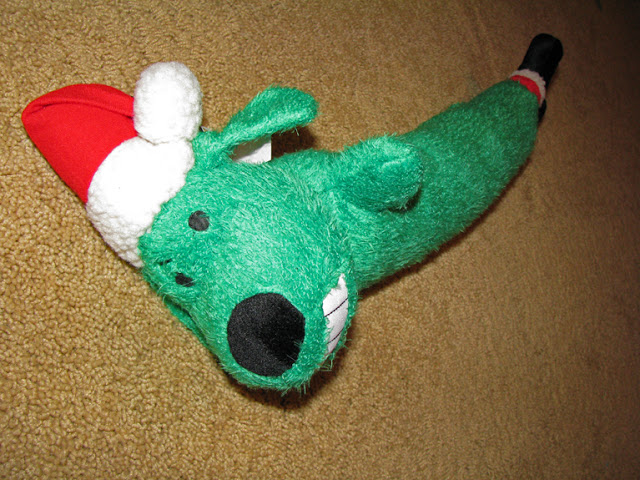
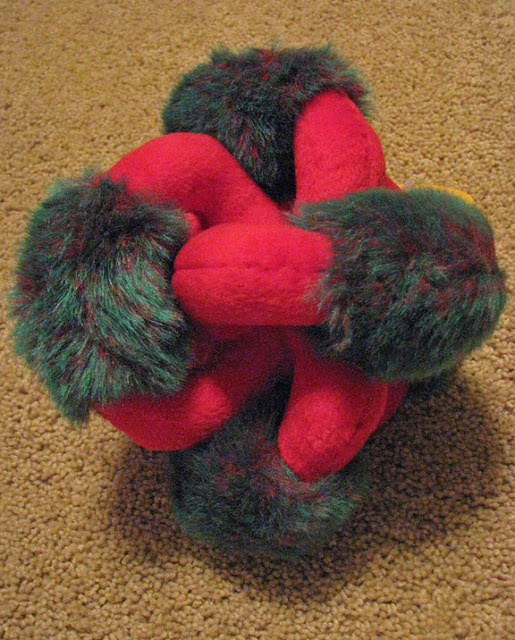
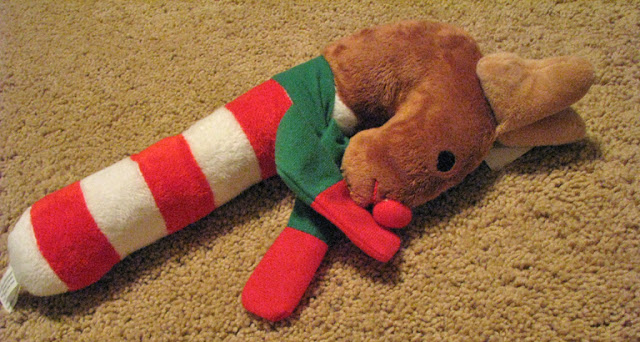
I also love nothing more than finding new toys.  I picked up a very cool Organic toy from Simply Fido  for a special pooch and two interesting Jeep dog toys I've been eyeing for months now.   I also got all three of my guys their Christmas presents.  I looked through a lot of toys and as soon as my eyes landed on the long green guy, sold.  Luke loves these long dog toys; I've never seen one this big, it's probably 2 1/2 feet long, he is going to go crazy.  Tilley gets the fuzzy green and red ring toy with a squeaker in each ring and Jessie gets the reindeer candy cane. 


It is important to consider a dogs physioloy and preferences when you get a toy for them.  Jessie has a small mouth and although she has quite the chomper, I like to get her easily squeakable toys.  This candy cane is just the ticket.  All the dogs I'll be buying for other than my own this year are so far small, which means they have to be able to get their mouth around the toy to squeak it.  There are a few things that I really don't like in toys; one is rope toys.  I've seen too many dogs consume string that inevitably comes off the rope.  Next I don't like toys that have any moving parts; never a good idea as they can come off.  And lastly they have to be soft, that is if they are th stuffed type toy.  I picked one up today that had a voice box type thing in it, not a great idea.

Frivolous spending?  Not on your life; the more toys a dog has the less chance that they will be wrecking your stuff.  Toys should be different; lots of shapes, textures and sounds.  My guys have two toy baskets; one upstairs and one down.  They use their toys all the time and are regularly strewn around the house.  Christmas morning we all look forward to the dogs recieving their presents with great anticipation.  I will have my camera ready and shoot the glory for all to see. 

Now go toy shopping.

Seizures


We just finished a seizure.  I was feeding the dogs their dinner; Jessie was done and gone to her bed, Tilley was licking out the last morsels in the bottom of her bowl and Luke was only mid-way.  He suddenly stopped eating and gave me that look.  I asked him to finish his dinner and he started to shake, I knew we had little time to go get comfortable.  I dropped the dishes and ran into the living room, he barely made it around the corner and it hit.   I wrapped my arms around Luke and gently let him fall to the ground.

The seizures are almost always the same.  It starts out slow, he is a little stiff but still with me.  Next comes the intermission, a short span between the two phases of seizing.  He relaxes but remains on the floor and within a minute he is gone, his eyes roll back and his body stiffens like a board.  This is the toughest part, I have to watch out for his legs; holding his front ones and keeping his back legs from gouging me.  All this while assuring that he does not injured himself.  Seeing this phase of the seizure is very disturbing, you do get use to it and just deal.


After his seizure stops he takes quite a while to come around, as soon as the panting starts I know he is coming out of it.  His eyes refocus and he sits up, always trying to get to his feet too soon.  Then for an hour afterwards he is stuck to me like glue, I usually turn the tv on and we get comfy on the sofa.  Tonight I'm blogging as he sleeps beside me.

Luke is epileptic, he hasn't had a seizure for sometime before tonight. He started seizuring at the age of 3.5, the normal onset age is between 3 and 5 years of age. We have been able to pinpoint his seizures to stress or chemicals pretty much. Stress can play a large role in many dogs that have seizures. That said; stress is dealt with differently by each dog, so how much stress is too much stress is very individual. Luke is a stress monkey so it doesn't take too much to push him over the edge.

Toxins also can play a big part in seizures and epilepsy. We keep all lawn fertilizer, weed killer type things off of our lawn. And I do not use harsh chemicals in our home; I opt for Baking soda and Vinegar or micro fiber cloths. All dogs with epilepsy are different so it is up to us and with the help of our vet to figure out the best approach as far as treatment. We have opted to go the natural way; with feeding real food and using management in the stress department. Luke has Grand Mal seizures (they are very bad) which are difficult to experience with him but they are luckily far apart. He may go as long as 6 months or more before having another.

Drugs used for epilepsy have side effects just like any other chemical drug. So do your research, know what you are giving your dog and make the best choice that you feel is right for your dog.

Dog breeds that are more prone to epilepsy are the Keeshond, Tervueren, Cocker Spaniel, Poodle, Collie, German Shepherd, Irish Setter, Golden Retriever, Dachshund, Labrador Retriever, Saint Bernard, Miniature Schnauzer, Siberian Husky, and Wire-haired Terrier.


Let me hear ya say YEAH


Silence is not always golden; sometimes it is the key to confusion.  This morning I was at the park; there was a woman walking behind me with her dog, she was training.  The odd thing about this team in training was it was eerily quiet.  If I was a dog my ears would have been turned back behind me as I attempted to hear even the slightest of sounds, nothing.  This got me to thinking; just yesterday I was making some of the most ridiculous sounds you will hear.  I was shooting a young dog and trying to get his attention.  I'm not shy about getting the shot or in training; getting my message across. 

As I loaded the girls into the xterra; the woman came by us again.  I watch intently with my listening fine tuned to this team; still nothing.  Okay; I don't know this woman, perhaps she couldn't talk but I doubt it.  I felt like yelling to her "I'm blogging about you tomorrow."    Even if you have no voice; there are still ways to communicate feedback. 

Feedback, feedback, feedback; I cannot say enough about FEEDBACK. 

Feedback:  evaluative information derived from such a reaction or response.

If your dog does something that you like; how do they know that you like it?  You have to tell them; and you can tell them in many ways.  The easiest form of feedback is sound; that is if you are dealing with a hearing dog.  Sound; and the best sound has a positive association, reward.  In training or simple educating; marking a behavior is all about timing.  If you strictly use food and remain silent it is very difficult to mark the correct behavior.  You may accidentally mark the wrong behavior and then end up with a behavior that you have to try to eliminate.  

Most of my training clients have had a good laugh or two on my account.  Oh; they are laughing at me, not with me and I am full aware of this.  "Throw a party;" yes, let your dog know how happy you are that they just peed on the grass and not the carpet.  "My neighbors will think I'm nuts;" is what I typically get in response.  Perhaps; but who cares, their time will come to do something embarrassing right?   Along with marking behaviors with a "yes" or "good dog;" some dogs need inspiration along the way.  Sometimes cheering them on in the form of whooooooop whooooop can put a spring in the step of a sluggish or non inspired dog.  You know; "put your hands up in the air," type of whoooooop whooooop.  I know you are laughing now too.  ;)


Okay; now that I've got you raise'n the roof, some dogs are very sound sensitive and you may need to tone it down.  Mellow feedback works just as well; in fact it works better on those whirlwind types.  If you throw a high strung sound sensitive dog a whoooop whooooooop; they may just spin out of control.  So; like I always say, each dog is different so what works for one may not work for the next.  Know your dog; know what works and what makes matters worse.  But whatever you do; don't expect your dog to read your mind, speak up. 

COME

Long ago when I was first training and working with dogs I learned the recall. Recall is basically the word for calling your dog. I learned the absolute worst way to get your dog to come to you; when I was but a young'n, 13 years of age.  The way I was taught was by anger and brut force. This was 35 years ago and some trainers still use these caveman ways of training. Looking back it is no wonder people deal with the behaviors that go along with this type of training. We would put our dog on the end of a long leash; put them in a stay and walk away. Then turn around and face your dog and call them, encouraging them all the way. But, if they didn't come we were to yank them in; reeling them in seriously and forceful. Ya, that really made them want to come in to us.  Any intelligent dog would be heading for the hills at this moment.


I honestly don't know what people were thinking back then; I know I didn't know enough to know any better.  I; like the other people in my class were listening to our teacher who we thought knew what she was doing. The harder we yanked the harder our dogs tried to stay away from us. Why on earth would a dog willingly walk into an attack situation? They wouldn't, it makes perfect sense to stay away and the association to the word "come" became a bad one.

Okay; enough looking back lets go forward. My dogs all come nicely even Luke and I have never yanked, hit or even grabbed them to do it. I teach all my dogs several verbal cues for coming to me. All mean to come to me; some just mean to come around me, while others mean to come and sit in front of me.  All the dogs know what these words mean and if they do not listen to them or come when told to; there is "or else."  Now you might be wondering what my "or else" is.   I know alot of people who know me and know my training methods can't wait to hear what my "or else" is. I'm such a positive trainer, what if my dogs don't come what do I do?

First your dog must know what "come" means.  In all fairness you can't enforce something if they don't understand it. Enforcing unknown commands is just  training at its worst. If my dogs do not come to me I go after them; I use my body language and they know I'm mad. I walk very upright and right at them, there cannot be any mistaking what I am saying. Depending on the dog that I am communicating with at the time is the degree of anger in my body. If you use too much for your dog may just turn around and run and that does you no good at all. So you have to be careful with your "or else". What you want to tell your dog is that if you do not come when I call you, I'm coming to get you. And you must teach them the difference between not coming and coming. There must be a clear difference, its great when you do come you get hugs and kisses and lots of praise and often a goody.

Training for a recall should start right away, once you have taught your dog their name the next most important thing is to come. You start in your home by calling and rewarding. Its as simple as that. My word come means to come near me, they don't have to come and sit unless I give the sit command as well. They rarely get a treat now but they do have to come. In the very beginning of the "come" training; the dogs get a treat and a party each time they come.  My guys are all well into their senior years and are expected to come when called; although I still try to instill a positive association with it. 

I also whistle which means the same thing and they all come to it; they really seem to like that one. My serious word is "here" and that means you better get to me right away and sit. For my Jack Russell it often means a treat because she has such a movement trigger that I have to compete with that high level drive. My poodles get a treat very rarely and just know that not coming has consequences at this point.
Once your dog starts to understand what come means you need to start getting some distance between you and your dog. Going outside while your dog is inside and calling them. The most important thing in training a recall is to NEVER associate a negative to your word. Dogs are highly intelligent and if there is something bad about coming, they're not coming. Coming should always be a good thing. So watch how you use your word, be very careful when you use it and if you need to do something like put your dog in a crate or leave a park use another word like "we're leaving" or "kennel" but don't tarnish your "come" word.

As I watch people train and see some of their mistakes some of the biggest are not enforcing.  Dogs learn that you don't mean a thing you say if you don't enforce so they do what they want basically. This is where you can make or break your training. My boy Luke likes to push and often will see how not coming works for him. I will call and see him give me that sideways "I'm too busy to come" look. One harsh sound from me to let him know that I'm not allowing his "not coming" and he is on his way.

Then he gets the snuggies he loves and I love!