Networking saves lives

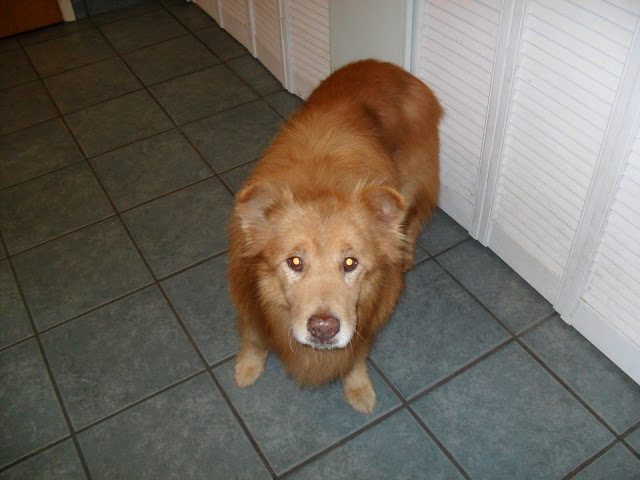
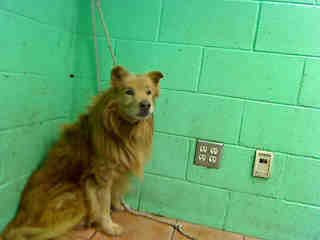
Photo from Downey Shelter

I've recently been sent several stories of senior dogs who were dumped.  The amount of surrendered dogs these days is staggering but the worst of the worst is the old ones.  You all know that I have three old dogs; well Luke is still a young'n at 10 1/2.  If ever our dogs needed us it is when they are old.   They need TLC and frankly they more than deserve it.  They require a soft bed, highly nutritious food an understanding and patient guardian and above everything else, love.  I cannot imagine turning a dog in once they have passed their prime.  It truly breaks my heart.

Networking is really making a difference though in the speed that rescues, rehabilitation and placement of dogs is happening.  And it's not just the young ones, the old guys are getting their turn as well.  Sharon Logan; who is one of the founders of Paw Protectors in Huntington Beach California sent this story to me. 

Sharon was contacted about a 19 year old Retriever who had been surrendered, she got to work immediately.  Action was swift as it passed through other rescues and volunteers via networking.  As each person shared more people became aware and all came together with one goal in mind, to save this boy.  The 19 year old retriever was quickly posted by Julie on petconnect.us.    It was very short notice BarkandPurr Alliance Fund offered funds to help transport and put Sharon in touch with Peg from H.A.R.T Animal Rescue.  Saturday night Rescue Paw Protectors agreed to get him out and transport him to Las Vegas Nevada where Peg Steed of H.A.R.T. Animal Rescue would transport him on to St.George Utah which would be his final home.  Saturday night the plan was set, Sharon from Paw Protectors went down to the Downey Shelter right when it opened at 10:00 met by Celeste Charles and pulled the 19 Year old Retriever named Red, Sharon then drove him straight from Downey to Las Vegas 3.5 hours away handed him over to Peg Steed of H.A.R.T.   Along with Kona a 7 Year Old Brindle that was Rescued from Devore 4 hours before his scheduled euth. Peg then drove them to St.George Utah and they now have loving homes. Sunday night Vegas traffic can be horrific; it took Sharon 6.5 hours to get home, but knowing that the 19 year old did not have to spend another night in the Shelter and would not die alone had made it all worth it!


Many, many people were connected in the effort to save "Red" the 19 year old Retriever.  Julie at petconnect.us, many people on FB who networked, shared, and donated funds to get him to safety, Paw Protectors and Celeste Charles who pulled him, Sgt. Torres at the Downey Shelter who was helpful and accomodating, BarkandPurr Alliance Fund who donated for the transport fees and Peg Steed with H.A.R.T Animal Rescue who found forever homes for 2 unwanted Senior Dogs.  People all across the country on FB united to save a 19 year old Retriever.
 
 
And look at him now.
 
When someone passes on some info to you about a dog in need, pass it along.  You never know who will lend a hand.

Obesity in the canine


The couch potato that stays nice and thin

First; how do you know if your dog is overweight?  Feel for ribs, you should be able to feel each rib.  Each rib should feel like it has a neoprene covering, not dough, just a thin layer of neoprene.  If you have to dig to feel them, your dog is fat.  I know, it can be a difficult thing to acknowledge but the sooner you acknowledge it the sooner you can get to work at getting it off. 

There has been a video floating around the net lately of a hugely obese dog.  It is very sad and the people who took this dog in are working to get the weight off.  An obese dog is no laughing matter, it is a serious one indeed.  Although they are attempting to take weight off of the dog; the damage may have already been done.  Having an overweight dog is serious; they run the risk of all sorts of weight related health issues.

It is sad to see a dog waddling around, every breath seems like a challenge.  Too much weight can be the end of normal dog activity.  They can't run and play like the other dogs.  Overweight dogs are at risk from many factors that involve carrying too much weight on their structure.   Jumping can be dangerous as their joints take a toll with extra weight.  Their vital organs suffer from over taxing from their mass and day to day activities can be a huge chore.  Many overweight dogs become arthritic well before their senior years.  Obesity can rob a dog of their young and active years, in fact it can rob years off of their life.

A fat dog is a serious health risk, some of the issues which surround obesity are:


Early arthritis
Diabetes
High blood pressure
Heart problems
Repiratory Disease
Ligament injuries
Kidney disease
Cancer
A shortened life expectancy

The list goes on and on.  Not only is there a high risk of the above listed diseases but the simple fact that weight will interfere with their normal life. 

Dogs do not get fat on their own; humans create fat dogs.  Too much of a good thing is often a bad thing.  Too much food, too many snacks, free feeding, the wrong food or foods and not enough exercise is what it comes down to.  Many dogs eat the proper amount of food, that is for an active dog.  My own Tilley has now at 14 years of age had her food intake cut in half.  She only has a very small walk a day and a couple of tosses of the ball, she doesn't need as much food anymore.  Any extra pound is just something that she has to haul around on her aging frame.

I remember over a year ago when I had to carry Tilley up and down the stairs for about 3 months.  It was a big eye opener, my knees were hurting and I realized that if I gained 44 lbs this is what I would feel like hauling myself up and down the stairs.

Of course there are health reasons why a dog cannot lose weight just like with humans.  That is for another blog.  If you have taken your dog to the veterinarian and they have gotten a clean bill of health other than too much food, then you have work to do. 
But you must take it slow, you have a dog that is not only too heavy but also out of shape.  You cannot turn it around in a day.  Small walks and cutting back food to start.  Work up the distance and intensity as your dog slowly sheds the pounds.  Dogs actually lose weight very quickly when they have a change in activity level and food consumption. 

I know many people feel that they should give lots of goodies to their dog because they love them.  If you really love your dog, take them out for a walk.  Feed them the highest quality food that you can and set a goal for you and your dog.  A sleek body has a much better chance of fighting off health issues.  And you'll have your pooch around for many many more years for it.

Association for Pet Obesity Prevention

Love your dog?  Time to get them into shape.

Change and dealing with it

Every single dog is different, much like humans.  And like humans; each dog deals with information in their own way.  I spent a good part of yesterday demolishing our family room.  We made a ton of noise ripping off two layers of old paneling, drywall and wood.  Jessie came down early on, had a look around, was confused but found her bed and lay down.  Tilley jumped onto the couch and made herself comfortable.  I was working on ripping apart a support beam down to its raw form which was on the other side of the room.  So although the dogs were out of harms way they were subjected to very loud demolition noise.


Both girls lay sleeping; every once in a while when I would make an exceptionally loud noise they would raise their head for a moment and then go back to sleep.  Luke on the other hand was pacing, he couldn't relax and when I would grunt and groan trying to get the dried old wood off he would run to me panting and wagging.  He is the nervous type; and he worries about everything.  Mostly he was worrying about me and all the commotion together.  He was not afraid of any of it but obviously did not like that I was in the middle of the mess.  I asked him to take a seat, to sit and get comfy in one of the leather chairs.  He did so until I grunted or shouted at the stupid wood that was not coming off.  Up he got and over he came to make sure that all was fine.


He stood vigilant in his duty to watch over me.  If I moved to a spot up high he ran to the top of the stairs so that he could see me better.  Luke is much more aware of his environment, he is very flexible as we slowly change it to an upgraded state but he worries during the process.  Tilley takes notice at changed environment but cares little about it.  She is very adaptable, she always has been and basically goes with the flow.  She has stepped as my protector several times over the years when she felt that she was needed but she does not worry needlessly. 

At this point Jessie can only hear the very loud noises or feel their vibrations so the construction does not bother her.  What will bother her is the change, it is very difficult for dogs with little or no sight to deal with change.  Jessie is also dealing with dementia so for several weeks we will be watching her like a hawk.  Just last night we sat in the living room watching tv.  We've never done this before because the tv is in the family room.  But because of the mess it is moved to the living room until we finish.  Tilley and Luke were fine with it, they lay on the couch and watched a movie with us.  But Jessie sat looking at the tv, obviously confused.  She sat for quite a while just staring at it, you could see that she was extremely baffled.  She then got up and went upstairs to one of the dog beds in our room.  No doubt she felt a sense of normalcy there.

Change is good, I think it's good for dogs and humans.  Without change we and they can get too set in doing and dealing with one way of life.  Inevitably change comes, in some form or shape and if you have never dealt with any sort of change before it can be life altering.  This is why it is so very important to change things around, not hugely but enough to be noted as a change.   Dogs who have never had to deal with it have a very hard time doing so.

Once our demolition got truly underway the dogs were removed from the area.  This in itself gave Luke something to worry about, he could no longer watch over me.  But for their own safety they were put in our room with all the blankets, toys, water etc.  And after an hour or so I joined them, having enough of demolition for one day.  

When it doesn't work


You've tried everything, you've called in the professionals, juggled dogs from room to room, become the best leader that you can be and still your two dogs cannot work it out.  I have talked to many people about this issue, there are many reasons why it isn't working but the bottom line is that it isn't working.  So what do you do when you have either bitten off more than you can chew or just plain made the wrong choice of dog to add to your family?  It is heartbreaking and many live a life of juggling.  Juggling dogs from room to room, someone always left out and the gloves are off if you slip up and someone gets out. 

Juggling is not an option that I would choose.  I want all my dogs with me at one time.  If for some reason two of them could not coexist after all the training, behavior modification and work I tried I would place one.  Yes, there would be tears and great sadness but I feel that every dog deserves a great life and one spent behind closed doors awaiting their turn is not that IMHO. 

The good news is that many people can turn it around with strong leadership.  Sometimes the dogs just need to know that there is no option but to get along.  At the first whisper of a growl in my house I will react.  I will never stop growling, it is a very important communication tool.  Chances are that it will be the dog who is not growling who will be stopped and redirected.  Just last night Jessie was acting very strangely, she stood smelling Luke's feet for quite a while.  I knew that he was uncomfortable with the behavior but let it go on for a bit so I could see his reaction.  As most of you regular readers know, Jessie has dementia so she does some weird things now.  When Luke did not growl or display at her I lavished big time praise on him.  This is so important. 

But if you've done everything you can do and it still is not working then it is time to consider placement.  Many dogs will live just fine as a singleton or perhaps with a dog of the opposite sex.  Once a dog fights with a house sibling the problem can grow.  This can lead you to live a life on the edge, never knowing when it will erupt.  In the wild with a pack of wolves there is often disputes like this.  Most end with the lower status wolf having to leave the pack or dead.  We often put so much into making it work that we cannot see that it simply cannot work.  We bare the burden of guilt (a feeling of responsibility or remorse for some offense, crime, wrong, etc., whether real or imagined), a very human emotion. 

Sometimes things just don't work the way we had planned.  It is essential when adding additional dogs to an existing pack to choose carefully.  Two dominants of the same sex can lead to problems.  Adding a dominant dog to an aging pack can lead to problems.  Taking on more than you can handle can lead to problems.  Whether you are choosing a purebred or mix makes no difference when you add a dog to your pack.  If you have great social, neutral type dogs then it makes your job of choosing much easier.  But if you have dogs with issues be careful. 

I am not saying when the times get tough, dump.  Not at all; I am talking about those who have done everything in your power to make it work and it still is not working.  You owe it to the dog that is not fitting in to help them find their perfect place.  And if that perfect place is not with you then you need to find it.  Many a dog are banished from the family to live a sad a lonely life in a outdoor pen because it isn't working, that is not fair for any dog. 

A dog deserves a happy home, not just a roof over their heads.  They are such a social creature that every one deserves a special human of their own.  Every dog deserves their own home where they fit in, and sometimes it isn't yours.  That can be very difficult to deal with, but we must always do what is best for our dogs.

Off leash-not on the street


Off leash; "when are we going to work off leash?"  Many of my clients have asked me this and then I ask them "what do you mean off leash?"  Often the answer is "so I can walk my dog without a leash," or "I see people walking their dog down the street without a leash, I want to do that."  Hmmmmm.  Off leash work starts right away; as soon as you add your new pup or dog to your family.  Much of our training is done with no collar or leash, but that is when we are in the safety of a home or fenced yard.  Off leash walking down a street is not wise no matter how smart or well trained your dog is. 

                                                                Photo taken by Judy Kargel

I was out with my old ladies this morning, even Tilley rarely gets off leash now.  Her hearing is failing and she cannot hear me enough to run free.  Jessie has never had the freedom of "off leash" except for very isolated areas where she can run for miles and not get hit by a car.  But the last time she was off leash was a very longtime ago now.  Dogs are dogs; obviously right?  And being dogs; they can veer from the norm occasionally.  So even the most trained dogs can slip up from time to time.  And if a slip up occurs in an area with serious dangers, you may regret the decision to take off that safety line. 

What if you are walking down the street and a cat runs across the road?  I had a cat run across the road this morning as I pulled into my driveway.  Luke spotted it right away so when I lifted the back hatch I gave him a very firm "wait."  I grabbed his harness and held tight until we got into the house.  Luke is very well trained but in a moment of elevated prey drive he could easily forget and bolt.  Once your dog is hit by a car it is too late to change your mind, too late to put the leash on just in case. So what I say is the point? 

Yes I work my dogs off leash, Luke that is and in a park setting.  He is very good even with distractions but why would I risk the chance of him being injured?  There is no point, he is going to be walking beside me anyway so why not have a safety line between us?   Working off leash is essential; you don't want to have to have a leash on to control your dog.  But working safely off leash and just off leash wherever are two different things.  I'm not a big leash fan but they are wonderful for keeping dogs safe.

Off leash work is great and it is a terrific feeling having a dog so well trained.  But; never do it on a street, road, lane, path or blvd that has moving vehicles or is even near moving vehicles.  That's just plain common sense, never the less people do it and dogs are injured or worse.   A leash can save a dogs life.

Being away

I hate being away from my dogs, I just hate it. I miss them like crazy and wherever I happen to be when I am away I'm on the hunt for dogs. I feel strange and quickly form a hole that needs feeling from a canine connection. No matter where I am my dog radar is on, I can see them from hundreds of feet away. I am drawn to them like a moth to a fire. Luckily I was given ample dog contact on this most recent trip. I was staying with my parents back home, dogless. No dogs live in their home but I wasn't there long before one arrived. My sister and her family showed up with their Nova Scotia Duck Tolling Retriever, Ruby. I've photographed her often and she never forgets me.

As soon as Ruby sees me she is heading towards the ground. With squinting eyes, a huge circle wagging tail, and lips pulled back she hits the floor and wriggles around. She is extremely submissive in her greetings with me and she delivers a big dose of canine for me. It was only two dogless days that I had to spend on my trip, thankfully. Over two days I filled up my dog need with Ruby. She is such a sweet dog.


Once Ruby left I had luckily set up a few shoots with family and friends. In all I got to photograph 8 dogs; and one of those 8 was only 12 weeks old. The cutest little Jack Russell mix you've ever seen. I have taken vacations when I've barely seen one dog, those are tough for me. So this one was a breeze although I still miss the closeness of my own dogs that you simply can't get from someone elses dog.

I got home yesterday; I couldn't wait to see them. As I walked through the door Luke was guard barking because of the noise the suitcases made coming in. All it took was one word and he was up off his couch and diving on me. As I've said before Luke likes to face bite and the more excited he is the bigger the bites. Having to compete with the girls for my attention he threw himself at me several times nailing me smack dab in the kisser. He spins and jumps, circle wags and dives at me while the girls push in for their share. The greeting lasted a good 5 minutes at maximum velocity and then it slowly calmed. With two arms arms I fully wrapped up the three for a huge snuggle fest. Two arms are more than enough to surround and hug three dogs, and man does it feel good to be home.

Good Thurday morning

Here are a few shots from my trip


Good morning everyone; bare with me this morning.  I've been away for a week and just got in late lastnight so I didn't get a chance to blog.  Had a fabulous trip back home, shot lots of Canadian dogs while I was there and will try to get more images posted later today. 

I missed my dogs desperately while I was gone but was able to connect with lots of dogs owners and get my fill of canines.  My greeting lastnight was amazing; and I have the bite marks to prove it.  ;)  More later.

Have a great day.

Sherri

Reasoning


When asked if dogs have the ability to reason I am left pondering. Is their amazing ability to survive and thrive in life due to their reasoning ability or is it a more learned ability to survive or simply instinct? When a dog performs an act; a behavior in life such as going to the cookie cupboard; is this an act of reasoning or the  fact that they have learned through life experiences through action and reaction?

Reason - the mental powers concerned with forming conclusions, judgments, or inferences.

It truly is a difficult question; dogs are amazing creatures who learn through association. They are much smarter than many give them credit. And I have personally witnessed many canine behaviors that have blown me away. But the question still lies; can they reason?

I'm more apt to answer no; even given many amazing displays of behaviors that have left me wondering how a certain dog could know or display a particular behavior. I still believe that most of the thought process of a canine is related to an action/reaction or some small form that comes to the conclusion.

Some behaviors are very instinctual, they appear from the inner dog and not from a learned experience. These may infact give the illusion of the ability to reason but in actuality stem from years of evolution and not reasoning at all. As hard as I conjure up scenarios that I have witnessed; each one can be related to an experience; action/reaction.

When you contemplate if in fact dogs can reason or not; you do have to factor in the way that we humans reason. We are given facts which we then mull around in our little gray matter to come up with our own variation of conclusion. But our ability to reason is challenged and guided by life experience; correct? Hmmmmm.

So in regards to reasoning I think dogs do not reason in the human sense of reasoning. But; I have no doubt that they think, which to me are two different entities entirely.

Temperament


A dog's temperament is the combination of mental, physical, and emotional traits or natural disposition. This is who your dog is; and your dog's core temperament comes down the genetic lines from her ancestors. When you go and see a puppy; you want to make good and sure that Mom and Dad have nice temperaments. That is not to say that somewhere down the line; perhaps a great Grandpa had a strange temperament, that can rear it's head at some point. But at least if you know Mom and Dad have a good temperament there is a good chance that your puppy will as well.


Temperament is #1 on the important list for me; but not for everyone. Many breeders love a certain look or physical attribute and will overlook a not so fabulous temperament to get it. A structurally sound dog is very important but a dog will short legs, a low tail set, crooked teeth or any other small fault can be overlooked by the average guardian. Temperament on the other hand can make or break a dog; it can be the difference between a great dog and a very difficult dog. I don't know how many "poor temperament" dogs I've met that had parents with the identical temperaments. Asking new guardians about the puppy choosing process; the parents etc and they say they couldn't meet Mom or Dad, hmmmmmmmmmm.

Too many dogs are bred who do not possess stellar temperaments. Many dogs that are spill overs from performance lines end up in the average Joe household; and most average Joe's can't deal with a drive level that is off the charts. Many people purchase a puppy from hunting lines; staying away from show lines. Their thinking is that they don't want a poofy show dog; they want a real dog. Well; real is what they get, real drive and an energy level to match that of the energizer bunny combined with an Olympic athlete. These dogs often become bored and highly destructive; had the guardian only known what they were in for.

Some of the greatest temperaments I've seen were in mixed breed dogs. A good temperament is a good temperament and something I love to see in any dog. One of the best I've ever seen was in a huge st. Bernard mix. He had lived on the street for the first part of his life; he was amazing. There is truly nothing like a sound temperament; a dog with a rock solid temperament should be put on a pedestal and bred.


Temperament is core; but a temperament can be altered somewhat. A dog can be taught to be better or worse by environment. I do not believe that a dog who is predisposed to a bad temperament is doomed. Dog behavior can be modified; you may not be able to change the core temperament of a dog but you can alter their reaction to the world around them. Fearful dogs can learn to fear less; dominant aggressive dogs can be changed by an experienced guardian.


Some dogs may seem as though they don't have great temperaments due to the lack of socialization. Given this hand in life a dog may never be all the dog that they could have been if placed into a different environment. So good dogs can go bad and bad dogs can go good if placed in the proper living situation. This is why I believe strongly in temperament testing; it is not the final word at all but it helps to place a puppy in the environment that they will most thrive.


Unless you and others can say AMAZING about your dog's temperament; then please alter them.


Ready..................ACTION


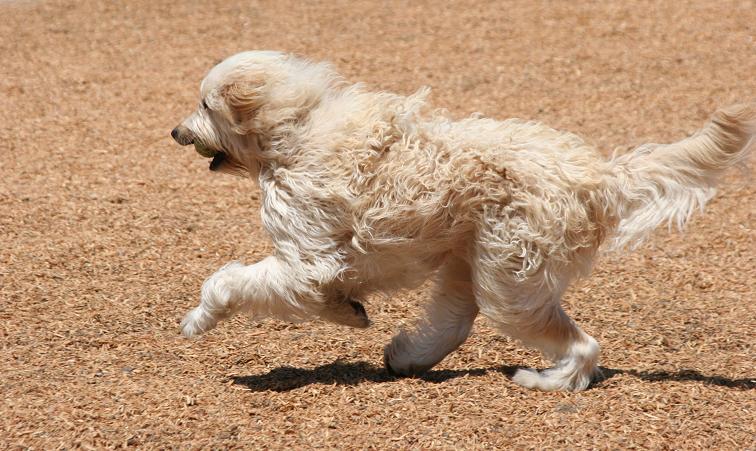
I've had a couple of great shoots this week; these are just a few of the images.  My absolute favorite type of photography is action.  The shots that you would have otherwise never seen.  Missed by our human eye.  After an action shoot I can't wait to get home to see what I've captured.  Often I am hoping that I got the shot that I think that I got.  And sometimes I'm completely surprised by what I captured.  Action shots can be so fast that you cannot catch the small but amazing images with our naked eye.


Action usually means fun.  Being that I shoot dogs, most shots are either running, swimming, jumping, diving, or catching etc.  So for a dog, this means fun.  And tons of fun for me as well.


A dog in motion is a thing of beauty, at least for me.  Of course I love most shots of dogs, sleeping, eating, playing and pretty much everything a dog does.  But if I had to choose............. it is action, a thing of beauty. 

Walk'n the dog


Good morning; what a great cool morning, love it. We all had toast for breakfast this morning; Luke and Jessie were on the bed with me and Tilley was still on her bed. I am perfecting my toast toss so that Tilley doesn't have to move from her bed to get it. At almost 13 it's getting tougher to get up so when I made a bad toss this morning I watched and laughed at her commando crawling across her bed and out onto the carpet. Obviously a much easier means of maneuvering.

Well onto leash etiquette. I'm a stickler for the proper use of a leash and when and where certain types of leashes are appropriate. I have tons of leashes but the ones I use almost all the time are my 8' 5/8s" cotton web leashes. They are long enough to give the dogs some distance and thin enough to wrap in my hand easily. I do not like the big thick 1" nylon leashes nor do I like nylon leashes in general as they can slide through your hand injuring you. I like the bungee cord type leashes; mostly when used with body harnesses though. And I like a nice short 6"-8" leash for walking through crowds.

Then there is the extension leash; most either hate or love them. I have one for Jessie and it is used ONLY when we are at the park and not around other people. If other people come around she is reigned into 5' length and locked in. Extension leashes can be dangerous and cause all sorts of problems; like cutting your leg. I've had my leg cut twice by the thin ones, clients let their dog out to the end to see me and then tried to haul them back while they were wrapped around my leg, smart. Dogs getting wrapped up in someone else's extension leash can be very dangerous indeed; fights start that way. When dogs feel trapped they swing into the fight of flight mode and being that they cannot move away they resort to aggression to get them out of the situation.

No matter what leash your dog is on when you meet someone else with a dog; do not allow them to become tangled. If they are becoming excited either move away and keep on your walk or drop your leash. But even if you drop your leash watch for tangled feet. If you have a dog that tends to be aggressive on leash, stay calm when you meet others with dogs and keep walking. Get a bit of distance by stepping off the path and calmly moving away but do not change your stride, do not have your dog stop and sit. When you do have to reel your leash in do it in a calm and smooth manner. Do not panic; the more calm you remain the calmer your dog will be.

Do not allow your dog to wander up to others without asking. Extension leashes are horrible for this although people do it on shorter leashes as well. When I walk Jessie I send clear messages that we do not want to meet with others. I get distance, step off the path and continue my walk. Sometimes the other people are so anxious to have their dog meet my dog that they don't register our message so then I must tell them that she is not social. But had they been paying attention they would already know that.

When walking with your dog on a leash have a look down at what is going on when you are walking. Does the clasp hit your dog in the face? Does the leash keep swinging and catching their ear? I see these type things all the time as the dog struggles to get away from the annoyance. Does your leash hang down to far and keep tangling your dogs feet? Is it too short so that your dog cannot do their much needed sniffing? These are all things to watch for.

No matter what leash you use; watch how you use it and hopefully it is not connected to a chain.

Stubborness

Today I was watching a woman attempt to walk her bulldog.  I was sitting in my car at a set of lights when I noticed them standing under an overhead cover of the bank.  I realized by the body posture of the bulldog immediately that the dog was not going to want to go into the rain.   It was cold and rainy and he had no intention of moving forwards.  She prepared to walk down the stairs and he put on his brakes, and when a 70 lb bulldog puts their brakes on, there is not automatic release unless you have planned for such an incident. 


It was pretty funny watching the woman pull and pull.  The harder she pulled the more firm this big boy planted himself.  There was no way he wanted to walk in the rain and no matter what she tried he was not giving in.  I had to move along so I never did see what the outcome was, but I have a pretty good idea.  Dogs are programmed so that when you push, they push back.  You pull on them, they pull back.   Just try it; walk up to your dog and gently push them, they will push back. 

So what do you do if you have a lunk of a dog that won't move?  Training, training, training.  Once you see that you are dealing with a certain type of mindset then you work with it.  In my opinion dogs are allowed to like and dislike things, but they also need to learn to listen.  Listening could someday save their life.  So you need a very positive association to a word that means "let's go."  That can mean many different things as we have previously discussed.  What is fabulous for one dog may not be the least bit positive to another.  So find out what makes your dog tick and use that. 

For Tilley it would be the chance to catch something, for Luke, probably the same.  For Jessie; food, most definitely food.  I taught all my dogs that "let's go," meant of follow along with me.  Meaning, stop doing what you are doing and do what I want.  Not always desirable but followed by a reward, is then given a completely different meaning all together.  As they caught on the reward became less and less but as always when the rewards get few and far between the praise becomes the replacement.  I can often be heard mushing over my dogs as they stop what they want to do to do what I want them to do. 

Afterall; like I always say, they are not robots.  And sometimes you are never going to win a tug-o-war.

A k9 heart


How many times has a human let you down? If you are like most people; your answer will be often. This morning I was having a bit of bloggers block; it happens now and again so off to the gym I went. On my return; I was welcomed with an exhuberant display from a tiny Jack Russell doing her best "wild stallion" display. She grabbed her toy and stomped her way through the house at top speed. She had seen me coming; she was looking out the front window as I pulled into the driveway so as soon as I came through the door the show began.

How great is it to be greeted by your dog? After my big JRT greeting Tilley came flying down the stairs with her tail wagging and her teeth giving me the biggest grin. Geesh; I'd only been gone maybe 35 min. but they were overjoyed to see me. This old lady was acting like she was just given a shot of super juice and charged around barking and growling up a storm. She did the best "huge" greeting that her old legs could muster. We ran out the back door to continue our big event as she latched onto my arm the way she use to many years ago.

I knew it was only a matter of time before all the excitement got Luke out of bed. He watched from the livingroom until he could stand it no more and charged out to join in the fun. I don't know what got into Tilley this morning but she was surely excited to see me. It is a bit sad to see her mind going through the process but her legs have a hard time keeping up. But no matter; this morning made me smile, her sheer happiness made me happy. It is contagious; watching dogs have fun and being happy just for sake of being happy makes you happy.

Although the elaborate greetings are wonderful ; sometimes it is in the quiet times that you come to the realization; just how wonderful dogs really are. They seldom talk back; never put you down, never lie (that's a biggy), never disappoint you, worship the ground you walk on, hang on your every word and are always, always there for you. Dogs are great listeners; something that I try very hard to be but they are naturals at it. You can tell them your deepest darkest secrets and they won't tell anyone........Mom's the word.

My husband commented earlier this week "dogs are way happier than people." This is so true; my dogs are rarely in a grump and the worst of it is usually that they don't feel like obliging to one of my requests. They are up and ready all the time; even at the age of 12 and 13 my old girls are up for fun. And now that it is there time in life for all the special tlc they are still giving. When your really need a hug they are there to give them out freely; they seem to draw away all the bad and fill you with peace and happiness once again. Amazing what one simple hug can do for a human. Canines have amazing healing power; simply by being a dog.

Confessions of an Agility Addict


Written by:  Helen King*

Have you ever watched dog agility on TV or in person and thought I could do that? Well you can!

Dog agility is one of the fastest growing canine sports on the planet. It is fun, fast and invigorating. The adrenalin rush is unlike any I have ever had and I used to ride show jumpers over huge fences when I was a kid! Agility builds a great bond between dog and handler, makes for a better house pet and gives you something to do in a very social setting without having to wear makeup or put on fancy clothes.

You may be thinking agility is a sport for young, fast athletes. NOT TRUE! I am 61, overweight (WAY OVERWEIGHT), had polio as a kid and now suffer from a mild case of post polio and three years ago I fell, broke my kneecap in half and have had two surgeries to repair it. I am in pain most of the time but a couple of Celebrex on the weekend and I am good to go. Once that adrenalin kicks in, all the pain disappears.


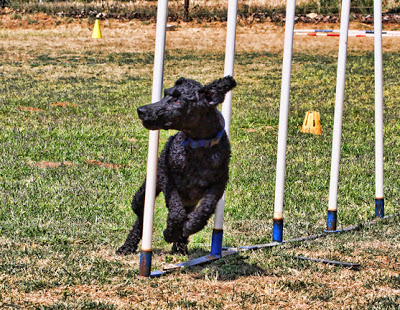
My husband is 73 years old and runs one of the fastest dogs in North America. He has a terribly bad back and neck and a painful knee but every weekend he is running around that agility field with two standard Poodles and a speeding bullet of a Border Collie.

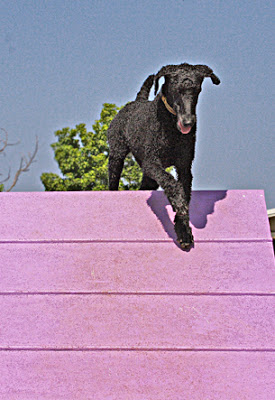
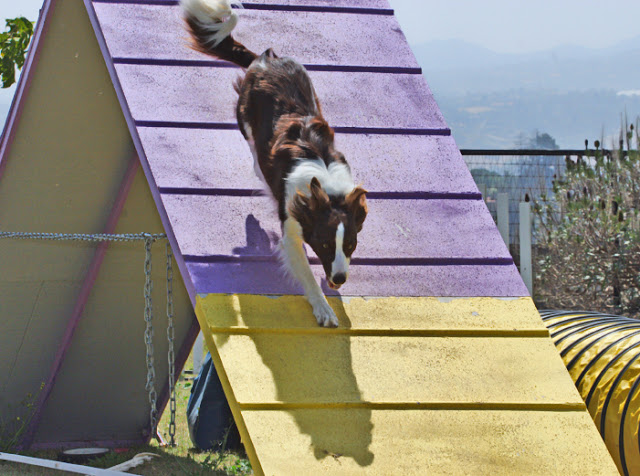
Here they are in action:

I had a friend who was competing in agility into her 90s! There are people who are confined to a wheel chair that compete in agility using a motorized chair. It is not just a sport for the young and the restless. It is just as much fun for the old and the restless! I can't think of another sport where a 73 year old can step onto the same field as a world champion and give them a run for their money and beat them! It is a grand sport indeed.

Agility is about training and handling the dog around a course of obstacles in the fastest time. At the highest level, where we compete, the dog is allowed no mistakes at all. The Poodle I run is not nearly as fast as my husband's Border Collie but occasionally, we might sneak in for a placement. We sure have some fun though!


There are many different methods when it comes to training an agility dog. We happen to use what we believe to be the best methods. Others use what they consider to be the best. The bottom line, however, is that only positive methods really work well for training agility dogs. The only punishment we use is just withholding reward if the dog gets it wrong. We try to put the best foundation we can on each dog and build from there. One of our mentors is Susan Garrett from Say Yes in Ontario, Canada. She has many books and DVDs available and recently began teaching online courses for those who do not have access to good instruction. Here is a link to her latest course on creating a great recall on your dog (it also builds an amazing bond between dog and owner)   Link

We started agility in 2000 with an instructor who knew very little about teaching agility the right way. We jumped around to 5 or 6 different instructors until we found one who really knew what she was doing. We have been with her for the past 8 years. It is well worth it to train with the best trainer you can find but the most important thing is to use only positive methods. If your instructor tells you to correct your dog verbally or physically, then you need to find a new instructor!

If you don't have access to good instruction, there are plenty of great books and videos out there. http://www.cleanhrun.com has a large selection and is a terrific resource for all of your agility needs.

As long as it is physically sound and not dog aggressive, any dog can learn to do agility. You may just want to go to classes and have fun or you may want to be on the World Team someday or you may be somewhere in between. When I started, I was only in it for the fun and had no intentions of ever competing. Now I am addicted and go to trials 3 or 4 times a month. We take off several months every year (usually in the fall) to give the dogs a well needed rest. During that time, we do not train, we just let the dogs run and do whatever they want. It is great R & R for body, mind and soul.

Dog that are doing any kind of agility, for fun or for competition, need to be very lean and well-conditioned. This is a good rule of thumb for any dog, not just the canine athletes! An overweight dog has a shortened life and can develop diabetes or other diseases associated with being obese.

We use toys and treats to reward our dogs. The best way to motivate dogs for agility is with the use of a tug toy. This interaction builds drive and love for the game and it is interactive with the handler. It is all about the bond between dog and person. That relationship is everything! We train so that our dogs love nothing more than to train with us. We want agility to trump squirrels, rabbits, or anything else that might be tempting!

If you would like to see our dogs in action, see us here on our Youtube page. On the top right side, there are 200 videos of us running our dogs as well as some training videos and some other videos we made just for fun.

If you think you would like to give agility a try, here is a list of resources that can get you started.

Say yes dog training

Clean run

Well, that should be enough to get you going! Happy training!

*  Born in Gloucester, Massachusetts, Helen King was being led around on a horse long before she could walk. Dogs and horses have been a major part of her entire life. Her mother raised Boxers in the ‘50s and ‘60s so.   Helen’s education of canine structure began at a very early age. 

In the 1970s, Helen raised and showed harlequin Great Danes and Basset Hounds as well a few other breeds. As an award winning sculptor, Helen has studied structure in depth to enhance her understanding of conformation and how it relates to movement.  She and her husband, Mel, bred successful race and performance horses for many years. One of the Connemara stallions Helen bred and owned was immortalized as a limited edition Breyer model.

Helen has been an Inspector for the American Connemara Pony Society for many years as well as a Connemara judge and seminar presenter. She attends seminars and lectures with the leaders in the field to
continually sharpen her eye and hone her skills.

Mel & Helen can be seen running the chicly shaved standard Poodles:

ADCH MACH 6 Josephine MFX, SACH, SCH, RN, CD, HIT, VCX, CGC
MACH Isabella O-EJC, EAC, OGC, NTC, AAD, JM, HIT, VCX, CGC
MACH 4 MeMe MPD, NR, HIT, VC, CGC
MACH Charisse Poodle NF, MPD, CGC
Crush (Border Collie) MX, MXJ, MXF, HIT

Helen’s lifelong passion has been the study of structure and how it relates to performance. She has observed hundreds of dogs in agility to compare conformation and performance as well as tracking the puppies to
maturity from the litters she has bred and evaluations of outside litters.

Cleaning up - four paws up for Earthpawz

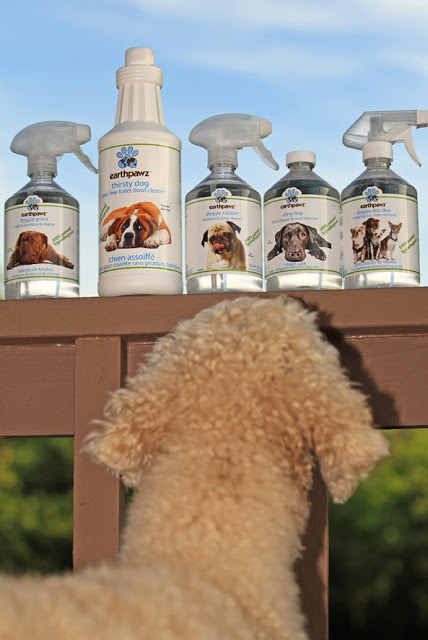
Image property of Earthpawz

First let me say that Earthpawz was having a bit of technical difficulties yesterday so if you can't get on their site, please try again later.  Definitely worth the effort. 

I recently received a new cleaning product to try.  Of course these are dog related cleaning supplies.  The company is called Earthpawz it's new and growing fast.  I first got wind of the products and company after seeing that it was being given away at the Oscars no less.  Earthpawz is a Canadian company owned by
Taren de St. Croix of Brantford, Ontario, Canada.  The company lauched it's products in September of 2009 and has exploded onto the market.

Luke; checking out the news guys in town.


If they were giving it away to the big celebrities at the Oscars, I figured that it had to be good.  I received my box of goodies and could not wait to give them a try, even if it meant cleaning.  And conveniently enough I had two pukey messes to clean up the day after my cleaning products arrived.  It worked great, my carpet is clean.  Much cleaner than when I use my normal carpet cleaner and now I don't have to worry about what I'm putting on the carpet. 

I think the biggest impact with these products, aside from the fact that they actually work is the message.  Each time I used the products I considered that this was not bad for my dogs.  I am already very conscious about what I use in my house but these products are meant to be used in a home with dogs.  My dogs don't drink out of the toilet but I know many that do, this is a wonderful idea.  Regular toilet cleaner can be some of the most toxic substance out there; extremely dangerous if your dog ever got into it.  This is not.


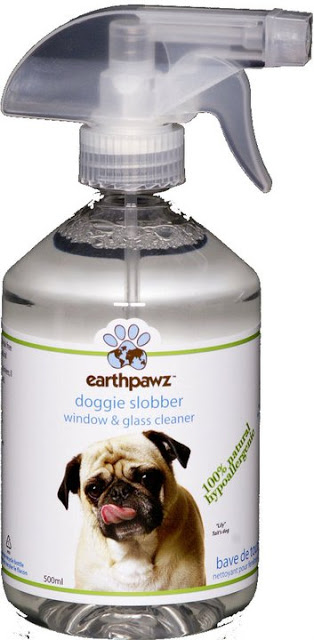
This image belongs to Earthpawz

Then I tackled the windows, you know all those nose prints?  I have them literally everywhere, anywhere there is a window at dog level, it is covered in nose prints.  As I sprayed the product on the window I again considered the fact that the dogs press their face up against the window.  Imagine using a toxic product to clean the window?  Earthpawz is dog friendly so spray away those nose prints knowing that you are not harming your canine. 

I've cleaned the baseboards, windows, toilets, carpet and last but not least the kitchen floor.  The marks came off the floor like a breeze and my floor is sparkling clean.  All of these products are pet friendly and work great, what's not to love.  What a great idea and I or we give it a four paws up for sure.

Epileptic Seizures


I was writing a blog as the poodles lay on their beds next to me.  I heard a stomp and looked down to see that Luke had started a seizure.  This was very unusual as he always comes to get me before it starts.  We get comfy and then work through it.  This one was different; I immediately got on the floor beside his bed and he was seizing but still there.  There is usually a phase in the second half of the seizure where he totally leaves.   There is no longer eye movement and no life in his eyes.  This seizure was very different.

The beginning or when I joined him he was tense but not stiff.  His eyes fixed but moving.  I could see that he was still listening as his eyes moved when Tilley made a noise beside him.  I talked to him a lot, I try to use words that I know he understands.  Mommy, Daddy, Brad, ball, outside etc.  I try my best to keep him with me.  This lasted about 3 minutes and he started to come out.  Normally this is when he has a very short break, 20 seconds or so and then it gets bad, really bad.  The break was long and I actually thought it was over, he started his customary panting that comes at the end.  It must have been 3-4 minutes and then he got a look in his eye.  A look that I didn't like. 

I cranked up the chatting, told him not to let it take him.  We worked hard to keep him with me and he did not leave this time, there was eye movement until the end.  It was a short phase and then it was over.  I hoped that there was not going to be another one, this was a very unusual seizure.  But this was the end, he started to get restless, shifting from side to side and his panting was heavy.  The panting usually means that he is coming out of it, and he was.  He does a great deal of sniffing around, making sure I am still by his side and smelling the surface beneath him.  I know he is trying to figure out what happened but there are no answers for him. 

He then tries to get to his feet, he always gets up too early and staggers around.  This is the time that I must be very careful to not let him fall.  He is also ramped up, panting heavy, fast tail wagging along with aimless pacing.  I always try to make him rest but he is persistent with his pacing.  Finally he lays down, it helps if I turn the tv on or get the laptop out, he knows these things mean that I will be stationary and he stops worrying.  While he comes out of it he needs constant reassurance, we make eye contact at least every 20 seconds.  He licks the drool from his legs and does a lot of air searching, searching for answers that never come for him. 

Luke is 10.5 and has had seizures frome the age of around 3 years.  We have chosen not to medicate him and switched him over to real food and try to keep his stress level down.  I also work very hard at keeping toxins out of my home which seems to definitely be a trigger.  This is what I was blogging about before he started to seizure.  That blog tomorrow.

Working through a seizure demands control.  Staying calm is important, you need to be there for your dog.  I have found that talking and keeping his attention does seem to shorten and lessen the severity of his seizures.  And touch is important, I think that it helps him focus on me, something other than the seizure.  Seizures are very scary the first couple of time you see them, especially when the dog enters the "gone zone."  Their eyes are fixed and they are no longer aware.  But it is important to help them through and make sure that they do not injure themselves.  Also be aware of feet and throwing heads, your dog may not be able to control their movements so be careful. 

Here are some excellent sources of information on the subject.

Canine epilepsy network


Canine epilepsy resource

EPI Guardian Angels

Purely Pets

Fido; FETCH!!!!!


Please, please fetch the ball.  How many people have dogs that don't fetch?  And how many people wish that their dog would fetch?  I have to admit that the whole game of fetch is very useful.  When you are in a pinch for time and need to get some exercise into your dog it comes in very handy, especially when they are a speed retriever.  Retrieving does not come naturally for all dogs; in fact many dogs just will not retrieve a ball.  And I know many people with a "retriever" dog that does not or will not retrieve.  Some dogs go after the ball with gusto but the idea of bringing it to you is not on their agenda.

Other dogs go through the whole, run after the ball, pick up the ball and even retrieve it.  But if you attempt to get the ball away from the dog, forget it.  So how can you have a dog that retrieves a ball and hands it over?  The first thing is genetics, not all dogs have drive to chase a ball, some watch it roll by and have no desire to chase the stupid thing.  For those types it is hard to get them to like it but sometimes you can.  You have to make getting the ball the most exciting thing in life.  Tons of praise and baby steps just might get you there.  Sometimes a cheering section is all that is needed.  If you make the object of the retrieve the only toy available, that helps as well.

For most dogs the problem with the retrieve is handing over the ball.  Even if they want you desperately to throw the ball, they are reluctant to give it up.  Afterall, dogs are not programmed to share.  And if they really love their ball or toy then handing it over can be tough.  So you need to teach them that the only way that this toy is flying for a game of chase is for them to drop it.  Never, ever go after it out of their mouth if you truly want them to retrieve and drop.


So once your dog likes the thing that you want them to retrieve, the trick is to have two.  Two items of equal value, so equal that your dog wants both.  You throw the first toy, with the other behind your back.  And when they run out to grab it you whip out the second one.  Once your dog picks up the item and has it in their mouth show them the second item.  This typically creates a "hey, give me that."  This is what you want, you want them to forget to drop the item in their mouth at first and run to you.  Once they are right near you tell them to drop if they know what that means.  If not; just wait holding the other item.  Most dogs will eventually drop the item and as soon as they do, I mean immediately toss the second one.  Quickly pick up the first item as they run after the second and start the sequence over. 

Once they start to catch on; use the word "drop" or whatever word you want.  This teaches them to drop the ball on command as well as to drop it fast.  The faster they drop the faster they get the second item tossed.  Do this practice for several days to weeks, depending on the dog.  Once the whole sequence is well imbedded in their head, you can stop the second ball or toy.  They should still habitually run back to you and drop the ball.  Make sure that you pick it up and throw it quickly.  Many people lose the momentum and a good retrieving dog by lagging on the throw and this might just be the thing that makes them turn and run with the ball instead of fetching. 


So out you go to find two equal objects of desire for your dog.  ;)

Gizzards


If you're like me you grew up hearing the terms gizzards, giblets etc around the holidays. It never really peeked my interest; I just knew that it was the gross stuff my Mom boiled up and it came out of the turkey. Now as a canine guardian looking for great food for the dogs I wanted to know. What the heck are gizzards?

While at the grocery store yesterday; looking for liver I spotted a good supply of gizzards and hearts. I did know that they come out of turkey's and chickens but I wasn't sure what they were exactly. They are cheap; so I bought four packages for the dogs. Once home I got out the computer to see just what these gizzards are.

Gizzards are secondary stomachs used by birds to grind their food before digestion. Very much like the tripe people feed their dogs and themselves; yuck. Because birds don't have teeth, they must fill their gizzards with small stones to achieve the same end result. Gizzards contain a very tough inner membrane, surrounded by a muscular pouch which provides the grinding action. Gizzards are part of the group of foods called offal, which also includes beef tripe, chitlins (pork intestines), and hearts; mmmmmmmmmm.

I am of Scottish heritage so I am very accustom to the stuff that some people eat. It really is what you are raised with. Steak and kidney pie, blood pudding, haggis (made from sheep liver, lungs, hearts, oatmeal and seasonings). I have to admit I love oatmeal; love it in anything but the other stuff? I'll leave that for the dogs to enjoy.

I have three packages of gizzards, hearts and liver fresh off the barbeque. They will be outside cooling; lest they offend any sleeping human members of the family in the house. But believe me, the dogs are going to be very happy.

Designing the next big fad


Okay I know I said I was going to talk about tiny micro dogs today but that will have to wait; I want to talk about "Designer dogs" today. The definition of a designer dog is a mixbreed or mutt. Two purebred dogs bred together resulting in the "designer dog" or mutt. There is a good chance that you know someone with a designer dog; they are everywhere. But not only are people scooping up this little 1/2 & 1/2s now they are breeding three breeds in to make even more of a mix; even more "rare." And folks unfortunately you are all buying it, the hype, the false advertising, the whole enchilada.


When I saw an adorable puppy the other day I simply said cute and asked her name; but the proud guardian felt compelled to tell me "she's a chiweiniepoo." Oh wow, you have a chiweiniepoo? I just smiled looking at this obviously very poorly bred dog with runny eyes and a gimp back leg. The guardian was beaming with pride; poor little thing I thought to myself. The young lady had no idea what evil lay behind the whole
operation where her puppy came from. People pumping out whatever they can for a buck.

So are these designer dogs really healthier than the purebreds of today? Nope. By breeding two dogs together you do in fact produce a larger gene pool but if they are bad genes then that is the bottom line. Breeding must be done with alot of research behind it; health and temperament lineage must be researched well before mixing dogs together whether they are of the same breed or not.


Unfortunately I have only met two really great ethical breeders of the "designer dogs." Most others are pumping out the large array of mixtures are in it for the money; I'm sorry to lay it on you like this but that is the fact. You may think by my stand on this topic that I am against the designer dog but I am not. What I am against is the unscrupulous people who are pulling a fast one on all the innocent people out there. Just as I am against all the people breeding purebred dogs and doing no health testing, no anything, simply pumping out puppies for a buck.

I stumbled onto a website this morning; a Designer dog breeds website. This was their actual web address even. There are pages of "designer" puppies listed and you can buy them right off the web like you would any other piece of merchandise. This is so sad; and the idea that people think that they are going to get a healthy puppy at the end their purchase is even more disturbing. This is where the puppies come from in your local pet stores as well people; the same horrific puppy mill.

The bottom line is buyer beware; do your research and if you want a mixed breed dog that's great. Just don't be fooled into buying a mixed breed dog for big bucks buying into the "healthier" hook, line and sinker. There are lots of mixed breed dogs out there that don't cost thousands of dollars waiting for a new home. And please; don't buy a puppy from a display list online; ethical breeders don't have pictures of puppies set up with cute backgrounds that you choose from.  Good breeders are hard to get a puppy from, they care where their dogs end up and do not just sell them to anyone who's got the money.

The reward system


If you are a longtime reader then you know by now that I am a positive reinforcement trainer.  I use rewards to enforce desireable behaviors.  When you use the reward system you cannot just assume that you simply whip out the cookies and your dog does everything you say.  Oh sure, there will be a few of you that this is how it happens for you but for the most, it is much different.  There are many things that factor into a reward.  First and most obvious does your dog like the item that you are offering?

Rewards don't always have to be food, quite often they are a ball, a frisbee, maybe a sock to tug on or even a big hug.  But the important thing is that the dog you are working with must enjoy this object or activity.  Otherwise they are not going to be hugely thrilled by it's offering.  In the olden days, way back 35 years ago when I was just starting out in my training life, a pat on the head was a great reward.  Let's just think about this for a second.  Your dog is heading out after a rabbit, prey drive is kicked into high gear, the catch closing in and you call your dog.  Like a great dog that your dog is, they stop dead in their tracks, turn around and come to you and you pat them on the head.  Hmmmmmmmmmmmmmmmmmmmm?    Do you think that the dog is going to drop everything and come next time?


Chances are the dog is never coming; it is busy doing a very doggy thing chasing a rabbit.  And if you really want to be able to call your dog off of things with that much value on them, you have to practice and practice and practice.  Not only do you have to practice, you must create the best, most wonderful association to "come."  That means REWARD; payment, payday, moola.  Basically we need to let our dogs know that if they listen to you, it will be worth their while and we do that by rewarding their behavior.

Take Tilley, she was a timid and fearful dog when she was young.  When we would be out somewhere different she was often very uncomfortable and there is no way, no matter what I tried that she would take food from me.  For her in these environmental scenarios, food was not a good enough reward.  At home they worked great, and she'd happily snorfle them down for whatever.  But out when she was stressed it had to be better, bigger and more amazing.  Enter the ball, the mild mannered tennis ball, unassuming what weilding great power.  She was instantly transformed, I mean incredibly.  There was no sign of timid, fear, nothing.  She was a lean, mean retrieving machine.  And she would do whatever it took just to sink her teeth into that ball.

Every dog has something, I'm not saying that it will be easy to find but it's there.  Sometimes an owner and I have just about pulled our hair out to find something that works as a reward in a stressful or distracting environment.  And even if it is food, often it has to be really great and maybe stinky food.  I've gone to training sessions many times with my pouch filled with roast beef, liver, hotdogs and some yummy chicken gizzards.

That said; on the other end of the spectrum is the treat that is too good.  More on that in another blog.  ;)