Shopping for new clippers


My favorite trimmers have officially died, sad but true.  About three and a half years ago I purchased a great new trimmer; the Laube speed trimmer and I never looked back.  I have a full sized Andis trimmer as well but for doing face and feet the Laube is by far the better tool.  It is quiet and it doesn't heat up; plus it is cordless so if I need to touch up Tilley I can do it while she relaxes on the lawn.  Having poodles means grooming, it is a simple fact of life.  Even though I do not clip my poodles as such; poodles, they still need to be shaved and trimmed.

I have been grooming for over 30 years; I don't mind doing it and the fact that I do myself has saved us thousands of dollars over the years.  I cannot imagine forking out 100.00 dollars every six weeks for each dog.  Yikes.  So I do it myself and I do it just the way I like it.  But now I need to shop; I will likely replace my trimmers with the same thing albeit newer version.

About a week ago I was trimming Tilley's feet when the tickling got too much for her she shot her leg out with such speed and force that she sent the trimmer flying.  It was too fast for me to react to and they landed on the concrete; I knew then that it was probably not going to be great for my trimmers.  I turned them on and they seemed to be fine; I finished Tilley and was happily surprised that they were not completely demolished.

Then yesterday I got the little lady out to clean up her face; trimming sessions are very important when poodles are young being that grooming is a way of life for them.  I turned on the trimmers and began, nothing was coming off.  Hmmmm?  I then remembered the Tilley incident; could this be a delayed reaction to landing on the concrete patio?  Well, whatever the reason they died.  I took them apart trying to figure out the problem but alas I am not a trimmer technician and these trimmers do have a life.

So now I am in need of new trimmers; I will ask all you groomers out there for recommendations on your favorite trimmers and if I don't hear about anything new and wonderful I will simply replace the ones that I love.  In the long run it is very little money to put out compared to having someone else do it.

clicker training


I've opted to use a clicker again; it's been a while.  Just a month ago I was cleaning out my "dog stuff" cupboard and found my first clicker; it had rusted so I pitched it.  Long ago I moved happily from conventional training to positive training, I learned the basic concepts of clicker training and loved the philosophy behind it.  Jessie was my first clicker trained dog; she is now 15.5 so yes I've been clicking for a while.  It is not new at all; clicker training originated with the large sea animal trainers in the zoos and aquariums.

I often see new owners out in parks clicking away; they are proud to be clicker trainers but many haven't grasped the whole "click" idea.  I see them clicking to get their dog to come to them; clicking as a cue but clicker training is not a cue but a marker.  Originally used as a way to communicate a correct behavior to the performing mammals.  Often the dolphins and whales were too far away or too high in the air to get a reward to for the appropriate behavior.  By linking the clicker sound to a reward they were able to mark behaviors that were far away.

Over the years I dropped the clicker and replaced it with the word "yes."  It is not as intense nor does it offer that loud instant sound that is so great about the clicker itself but it is a definite alternative.  Now that we have a new addition and after talking to the training at our puppy classes I decided to give the clicker another go.  It definitely breaks noise and distraction better than yes and although I hate the whole idea of having to hold yet something else, I'll use it.  I will use it until we get on a role and likely switch back to "yes."

Karen Pryor's Don't Shoot the dog catapulted clicker training into the training world and since then it has steadily grown.   The book is a fabulous read and if you have not read it already I suggest that you do.   After reading Karen Pryor's book many years ago it changed my world as far as training is concerned.  So yes it is a good read.

Timing is all important with clicker training and it is probably one of the hardest things to teach a new dog owner.  This is why I opted not to use clicker training in my own training of clients.  I felt a hard negative push back from owners as they struggled with a new dog, training and the whole clicker thing.  But if you are dog savvy and/or willing to learn and plod through the beginning of clicker training then it is definitely a great way of teaching our dogs.

Many behaviors can be quickly learned with the clicker.  It is great fun to shape behaviors with the use of a clicker.  My little JRT (Jack Russell Terrier) literally learned to jump through hoops, crawl, pray, spin etc etc with a clicker.  The clicker also helps a dog learn to learn and learn to offer new behaviors which is something that many dogs have a problem with.  Luke is one of those.

So if you've never understood the clicker or are just curious; get Karen Pryor's book and have a read.


Re-introducing


Good Monday morning everyone, I've been away for four days and it is nice to be back.  We were in NYC, NJ and CT.  This trip was a bit different, well at least the away preparations were different.  We left our old dogs at home with the sitter and Elsa went for a sleep over at a new sitters.  Having a puppy and old dogs together is a huge amount of work so we now have a second introduction to do.  Re -introducing dogs always comes with a lot of behaviors.  Even if they've lived together for years there is a re-establishing period.

Many of my training clients over the years have said that after they return from a trip that their dog behaves quite badly.  Even if you only have one and they go off to board or are sit at your own home there is a re-establishing period.  This morning I am picking up Elsa and there will be a short time when everyone is out of sorts again.  She is a very active girl and will no doubt give the old dogs a lot to growl about.

As you all know I run a tight ship and I would imagine Miss Elsa got away with murder while we were away.  Implementing rules and regulations right off is essentially important for a quick and obstacle free re-introduction.  We will also have some obedience and manner refreshing; I'm sure those slipped as well.  There will also be almost a week of missed new obedience to catch up on.  Puppy learn so quickly; Elsa is like a sponge now so best to take advantage of it.

Our old guys may have thought now that she is gone, she's gone.  Maybe she was just a visitor for a few weeks.  They will voice their disapproval and show their joy at seeing her again.  My job is to get our life back on track as quickly as possible by being a strong leader and not allowing any nonsense.  And we'll be back on track once again.

Dog people


I love talking to dog people; when I'm away on a trip it is even that much more important to find these folks.  I miss my dogs desperately when I am away so I'm always looking; always searching for someone who wants to talk about their dogs.  So far I've been lucky; almost every trip away has produced some dogs and their people for me to chat with.  This trip has kept us on the move but I still found a few. 


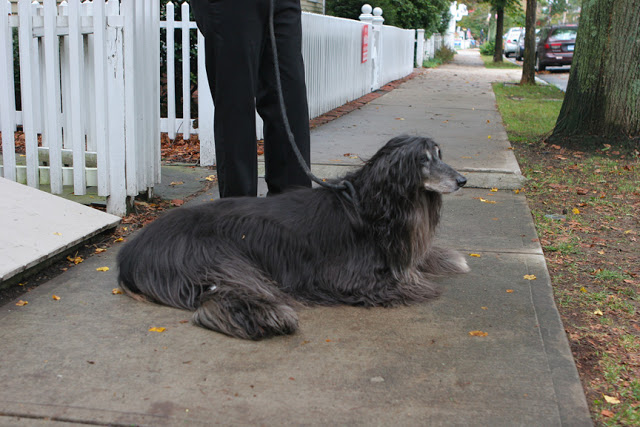
I met a few dogs walking in the streets of NYC; happily trotting along with the companions.  With horns honking, a steady stream of people and no grass in sight they seemed quite happy.  Once out of the city is where I got to stop and talk for a bit.  I met a gentleman with his Afghan, Sinbad.  Sinbad was eleven years old so we swapped old dog stories.  He looked old as he plodded along after his owner until another dog showed up across the street.  Sinbad lost years in a moment and displayed and strutted all the bluster he could for this other dog.  It made me smile.


Then we headed down to the shore; there sat the dog who Sinbad had tried so hard to tell off.  He was sitting with his owner so of course we headed over.  This guy was supefor friendly and crazy energetic.  My husband missing our guys as well had a big greeting with this rambunctious dog.  He stopped for a moment; suspicious of my camera, but that didn't last.

I'm glad that there are so many dog lovers in our world, makes finding a dog fix a little easier on my trips.  ;) 

The big and small


Dogs are dogs right?  Well perhaps they are dogs but they are far from the same.  You can really see the outward differences when you are looking through the eyes of a new puppy.  Two days ago when we attended our puppy class, there was a very small boxer in one of the rooms.  As we went in we were asked to move to the big room; this puppy was at his first class obviously and he was quite literally frozen.  Tail down, curled up body posture with a fixed trance like stare, he had shut down and frozen.  Perhaps the puppy had been in a secluded litter, they didn't get out much so anything can make them freeze.

As each dog enters the playroom for the after learning part of class; they are quickly assessed.  Funny how some dogs just give off immediate "not friendly" body posture.  Then others that look very scary to us, give off no "not friendly" posture.  The scariest dog so far that Elsa has met was a little white Bichon; surprising.  Just the other day she was running along side a huge Great Dane jumping up and her mouth to invite play. 

Many people have told me that their dog hates husky types, some Golden Retrievers and others small fluffy ones.  It can mean that they have had a bad experience leading to negative association.  They can also just have a dislike for a reason that we cannot figure out. You can always help you dog get over these issues with the implementation of positive association over time. 

If the problem lies with the dog approaching; if the dog is not well versed in proper dog language then just pass on by.  Don't stir things that don't need stirring, move onto the next friendly dog.

The wobble board


I had Elsa at her second puppy class yesterday.  We spent most of the time going over some agility equipment and things that might be new to her.  I'm not sure if agility is the way she is going to go but it was definitely great to have her try all these out.  Anything new is good when they are this age (13 weeks).  So she ran through the tunnel which I was really stoked about because up until several months ago we had our own tunnel that had finally died and I'd had to throw it out.  I have several shots of my other dogs using it; they all loved to run through.

She went through the tire which was like nothing for Miss Adventurous.  She experienced some new shaped ball things and walking behind a stroller.  The best thing by far was the wobble board; something that all of you in agility would be familiar with.  As I am not an agility person; at least not yet I'm not this was new to me.  A board with a ball underneath it that a dog stands on to acclimate them to the feeling of wobbling.  Mostly used for teeter totter training; it gives the dog experience standing on moving objects.

The wobble board

I wasn't sure how Elsa would feel about this; I know that my boy Luke would have had a cardiac arrest.  But if he had been introduced to this as a very young puppy it would have given him some wonderful experience.  I have seen many dogs when put onto a table, crate top or anything else that might wobble turn the whole experience into a shaking horror story.  Often when something is unstable under a dogs feet they will instantly try to correct the situation which immediately set in motion a very bad experience of more shaking as the dog tries to solidify their stance.  This wobble ball experience will help to take away that panic reaction.

As Elsa approached the board and then placed her front feet on it she acknowledged the tip and was rewarded.  She went on and off the board several times with half of her body and it was only the one time that she was on with all fours that she had a tiny bit of concern.  I'm sure that the experience would be much like someone on a surfboard for the very first time but not knowing you were going to step on one on top of that.  She did really well and I will be asking my hubby to make me one of these.  Perhaps I'll even get Luke up on it; well maybe he'll at least try one toe.

I was convinced after seeing the board and pondering about it for a while that all very young puppies should experience this.  It would be wonderful to have them get acquainted with the wobble sensation.  It would do them all a great surface in their future lives no matter where they go or what they do.  If a breeder had one of these boards they would have to give each puppy individual exposure as you would not want anyone having their toes squashed under the board while others climbed on top.  But one on one is very important even as very young puppies.  You would have to be careful not to overexpose or frighten working up to a full wobble as each puppy progressed.

It is a great tool for confidence building; something that Miss Elsa is not lacking in any way shape or form.

Leave it/drop it


No two verbal cues are more important than "leave it" and "drop it" with a puppy.  As you get out and about,  undertaking the much needed socializing; you realize just how much stuff is on the ground.  I've been going to many different places and now parks that Elsa has had her last set of puppy shots and it's all about keeping her safe by not letting her devour everything in sight.

We started both of these behaviors right from the get go; we have bark in our yard which was a big concern.  Just last year we put in several new gardens with the finishing touch being bark.  Before we got Elsa I clearly remember gardening and thinking to myself "this might be a really bad idea."  Of course she was at first fascinated with it; she was never outside without us so we were able to nip the "bark" issue in the bud.

"Leave it" is used before a dog has an unwanted item in their mouth; that means you have to be on the ball.  Keeping one step ahead can be tough when a puppies head is constantly on the ground.  We started "leave it" before actually sitting down to learn it.  That meant a loud "leave it" was used just to get attention and then getting the reward in there quickly.  Basically it is all about "don't eat that and I'll give you a goodie."  In the beginning you must reward every "leave it."   As the dog gets older you can wean off of treating every time saving the big and impressive "leave its" for the rewards.

"Drop it" is used once the dog has something in their mouth and you want it out.  There are times when you are simply going to haul it out of there quickly but you must also do a trade.  If you only use a physical emptying of the mouth each time, your dog learns to run and swallow, a dangerous thing.  It is important to also use drop when you can return the item; this helps to lessen the run away reaction as well.  When your puppy is chewing a safe toy, ask them to drop, give them a treat and offer them the toy again.

"Drop it" is started with a bribe; your puppy must consider the bribe good enough to spit out the bad stuff. By offering a treat trade you are able to get into their little brains and erase the run away and swallow response as well. Of course getting to them before they have something bad in their mouth works best; that way you can reward them for not picking items up.

Both of these behaviors are essential; otherwise you could be doing a great deal of chasing your puppy down and mouth hunting for dangerous items.  This in itself instills the reaction to run; getting rid of it is fairly simple, it just takes work.

City vs. Country


I'm a country girl through and through; I grew up in the country as a youngster.  Although we lived way out in the sticks, the suburbs slowly encroached us causing me to seek out more country once I got married and we were looking to buy a home.   My husband, kids and I moved out to a small town in Ontario Canada called Carp; I loved it there and we had land.  Our house was smack dab in the middle of farm fields so although we only had around two acres we were surrounded corn and wheat crops.  I loved it.  Our dogs only had to use leashes when we went into town and having dogs with too much pent up energy was not an issue, ever.


Then we moved to California; what a transition, wall to wall houses with tiny match box yards.  This of course is far from city life but it is very confined compared to the country life.  Daily outings are necessary and leashes are a way a life.  I'm always off trying to find a vacant field or park where I can let my dogs rip; not an easy task.  My dogs now have had much more variety in their life being that we visit places I probably would have never taken my dogs back when we lived in the country.

Real city life is something I have yet to live with dogs; although I did live in an apartment with my first dog, but not in the city.   City's are lovely, I enjoy visiting them but I do not want to live in one.  I would like living outside a city so that you can have the best of both worlds; country and city living.  I'm going to be visiting NYC soon, Central Park and all.  I have never been so I'm checking out dog areas to see when we are there.   If anyone reading this lives in NYC with dogs I'd love to hear from you.

I've been thinking about city dogs a lot being that we are visiting one of the biggest cities that there is.  I've been pondering apartment life in the city with dogs.  When I first moved out at the age of 18 I had an apartment and a dog; it was definitely a different lifestyle.  Life must revolve more around outings vs. opening the backdoor and letting them run in the yard.  Of course a lack of a yard or large yard is never a reason not to have dogs; I know many very happy dogs who have simply a tiny patio or nothing at all.

Socializing is of course mandatory in a big city especially like NYC.  It's wall to wall people, dogs and cars so  space is not easily come by.  They must be comfortable with it all or lead a very stressful life.  I am really looking forward to the visit and hope to take as many photos of Dogs in the City as I can find.  I will be spending a good amount of time researching  hot "dog" spots to visit.

One of the many wonderful things about dogs; they adapt to pretty much anything.  

Patience is a virtue

Patience is a virtue; true. Just about everything works out better if you have patience. Over my years of training I have incorporated patience into working with dogs. Unless you are using the harsh choke'm method of training patience will do well for you. Many behavior modification solutions need to be well thought out; usually a quick fix is not in your best interest.

Watching requires patience; watching and taking in tells you alot about whatever you happen to be watching. Keeping calm requires patience; and sometimes dealing with dogs, keeping calm can require a whole lot of patience. Take for instance a common issue at my house. I am on my computer and the dogs are outside; Luke decides he would like to come in; so tries a couple of barks.

My computer is at the back patio door so I simply tell him to "stop." He thinks about it but decides he would rather come in. I am remaining completely calm as I tell him to stop. One more bark; just a trial small bark to see if I really mean for him to stop. I calmly walk downstairs and look at him out the livingroom patio doors; there are no words, we have a visual understanding and he goes and lays down.


Patience in my photography not only helps the dogs but it helps me as well. There are many instances that one could lose their patience; afterall dogs are unpredictable and react in many ways to many different things. So if I did not have patience I could loose my cool very quickly. I often have to explain to the guardians that I am perfectly fine waiting for the dog to calm or relax.  Watching the owners become flustered as their dogs do not cooperate requires patience as well.  I let them know many times that I am very patient and not to worry about their dog; we'll get the shot.  But it is my own outward appearance that matters them most; I have to look calm for them to really believe that I'm not bothered by the unwanted behavior or length of time to get the perfect shot.

Losing your patience almost always results in doing something you will regret later or doing something you will have to undo later. So yes, patience is a virtue.

Thanksgiving - dogs


It is Canadian Thanksgiving weekend which causes the "what are we thankful for" phrase to be pondered around the country.  This being a dog blog I will talk about what I am thankful for concerning my dogs and dogs in general.  First off and fairly obvious is the age of my dogs; having seniors nearing 15 and 16 and still healthy is amazing.  Each time we stop to talk to people and share the age of our dogs, people are shocked.  The most shocked is for Tilley and Luke, probably Luke even more so as he runs around like a young'n.  I met a woman the other day with a 9 year old hobbling around the park; when she heard that Luke was 11 she stood there in silence staring at him.


I am also thankful to have my senior dogs here to school Elsa, the real young'n of the family.   I am more than grateful that Elsa has joined our old family and brought some vigor back into a very sedentary lifestyle that we had become.  Just last night as we sat to watch a movie, Luke hauled himself from his very comfy and ritualistic spot on the couch to play with the puppy.  They ran outside and in, charging after each other with sheer joy.  Nothing is as glorious as seeing your dogs having great fun; especially the young and the old.

I am more than thankful that I have a wonderful husband, one that gets up at 4:30 in the morning to let the puppy out giving me a much needed break.  ;)  He has an huge spot in his heart for the canine species giving him an amazing relationship with each of our own dogs and compassion for all dogs.  

For all those who rescue and rehabilitate dogs; I am thankful for you all.  Light is being shone on the dogs and things are slowly changing.  As far as abuse, over breeding, fighting and  neglect issues things are moving far too slowly but at least they are moving; there is a glimmer of hope over the horizon.  A large movement towards the welfare of the animals and as the great Ghandi once said.

The measure of a society can be how well its people treat its animals." ~Mohandas Gandhi

Frenzy eating


Frenzy - wild excitement or derangement.  Yep that sums up Elsa during eating; it is up until now the only issue that we have had.  Over the thirty some years that I have had my own dogs I have never had a dog who was a frenzy eater.  If you have never seen a frenzy eater it is literally a hoover on steroids.  She can barely contain herself at feeding time; there is no chewing involved, only suction at lightening speed.

So as we quickly discovered that she was a frenzy feeder things changed in our house.  We have made her work for her food.  Much of her food is never given via a bowl but used as a reward for her work.  When she is fed with a bowl she is either spoon fed or hand fed from it.  I have fed her by dropping small amounts into a bowl with my hand and placed chicken/steak into her bowl while she is eating.  With a frenzy eater it is very important to establish that a human hand around the food bowl.

I'm really not sure if there will come a point when she slows down; as I said I have never had a frenzy eater.  You all know what I go through trying to keep Luke fed; he is at the opposite end of the spectrum from Elsa as far as eating is concerned.  When we were looking for a puppy I hoped and I hoped that we would not get another picky pants as it has taken so much work to keep meat on the boy.

Even though Elsa eats at a faster than light speed, her intelligence works at the same time.  If it is feeding time she rounds up all the dogs; she knows that she eats last and runs to each dogs spot making sure their bowls are placed quickly so that she can get hers.  Watching her do this is pretty amazing; the fact that she knows the order of bowl placement is after such a short time is crazy, but she is a poodle.

I hoped for a non picky eater for the the next....................be careful what you ask for.  :)

Vestibular disease


Lately I've been running into a great number of dog owners who have never heard of Vestibular disease so I decided that I would repost some of my past blogs on the subject.  It is so important to know the signs; sadly many people euthanize their dog at the onset thinking that they are doing what is right.  The symptoms of the sudden onset are definitely frightening but it all changes quickly.  Here are the past posts on the subject and as a side note Tilley is now 14.5 and doing amazing; crooked but amazing.

Link on Vestibular #1

Link #2

Link #3

Elsa's first class


Well, I have to say that Elsa's first official obedience puppy class went amazing.  We attended the puppy class at Wags and Wiggles.   As you all know I was taking her to class to learn in a different environment and socialize which is so very important.  I thought that there may be a couple of other people but it was just us which ended up being fine because the teacher had an adult Great Dane and a four month old Sheltie pup to work around.  Elsa met the big gal right away in the parking lot; her tail initially fell but it wasn't down long and she was trotting alongside the huge dog on our way to class.

Once in class Elsa was put onto a tie cord; a cord attached to the wall and that is where she stayed to do her work until class was done.  It did make not having to hold a leash much easier to work.  Elsa sat and watched for much of the class; she did what was asked of her and wagged her tail for most of it.  She learned to give eye contact when she hears her name, learned to sit when someone approaches her and the touch exercise.  The touch exercise is when the dog uses your hand as a touch target.  It can be used for many purposes once it is reliable.  Most dogs love the touch exercise; I have taught it to all my dogs and used it extensively.

The teachers sheltie pup was amazing, so smart and attentive for a 4 month old.  I'm sure that's where we will be in another month; at least I hope so.  Elsa is an intense type of dog; very much a working girl and I can see having to rack my brain to stay ahead of her in the game of training.  She catches on so fast and easily that I find myself going through the beginning, middle and final advanced stuff very fast.

So after the learning part was over it was play time; socializing, which is actually learning as well.  The play time is held in a huge warehouse type room; amazing for the dogs to run in.  Elsa met a 13 week old aussie pup who was smaller than her but very intimidating, she didn't care for him at all.  He charged and ran and jumped over her head hitting her hard, not her cup of tea on a first meeting.  She pretty much liked everyone else but stayed close to the humans; especially one trainer human who she really took a shining to.

She did great for her first day; after class we got a tour of the facility, they have a daycare/boarding place as well.  It was pouring so there were a lot of dogs there; rain is a rare occurance here in SoCal.

First class


Elsa is going to her first obedience class; her puppy class is at noon.  Puppy obedience class, the phrase is sort of a contradiction of words.  Puppies in a room together to learn, hmmmmmmmmm.  Puppy class is basically a socialization time; the real learning is done by the owner who then takes the information home to teach to their puppy.  Most puppies have a very difficult time learning in a stimulating environment.  Not Elsa, nope she can learn just about anywhere.  Sure she will be slightly distracted but if there is food involved; she's on it.

It has been unbelievably easy so far teaching her anything; she already does sit, down, leave it, sits at the door to come in and is going to start on X today.  I will blog on the X behavior tomorrow.  Once we get that we will attack boundaries.  Class should be fun today; I am attending a very well known training facility that uses positive reinforcement methods of training.   The classes are on a drop in schedule so I'm hoping that on a Wed. there are some puppies to socialize with.

When I use to hold group classes we always had time at the beginning and end for social time.  Social time is a funny thing; a little is good, too much bad.  Once a dog get wound it's hard to unwind so less is more in class.  That goes for play time as well; often things go great until puppies get wound or tired and then things start to unravel.

With puppies, learning needs to be done in small amounts so an hour is going to be a longtime.  I'm not sure what we will cover in the class on this first day but I guess I'll find out.  I'm looking forward to seeing how Elsa does with the other puppies.  I'll let you know how it goes.

First class


Elsa is going to her first obedience class; her puppy class is at noon.  Puppy obedience class, the phrase is sort of a contradiction of words.  Puppies in a room together going to learn, hmmmmmmmmm.  Puppy class is basically a socialization time; the real learning is done by the owner who then takes the information home to teach to their puppy.  Most puppies have a very difficult time learning in a stimulating environment.  Not Elsa, nope she can learn just about anywhere.  Sure she will be slightly distracted but if there is food involved; she's on it.

It has been unbelievably so far teaching her anything; she already does sit, down, leave it, sits at the door to come in and is going to start on X today.  I will blog on the X behavior tomorrow.  Once we get that we will attack boundaries.  Class should be fun today; I am attending a very well known training facility that uses positive reinforcement methods of training.   The classes are on a drop in schedule so I'm hoping that on a Wed. there are some puppies to socialize with.

When I use to hold group classes we always had time at the beginning and end for social time.  Social time is a funny thing; a little is good, too much bad.  Once a dog get wound it's hard to unwind so less is more in class.  That goes for play time as well; often things go great until puppies get wound or tired and then things start to unravel.

With puppies, learning needs to be done in small amounts so an hour is going to be a longtime.  I'm not sure what we will cover in the class on this first day but I guess I'll find out.  I'm looking forward to seeing how Elsa does with the other puppies.  I'll let you know how it goes.

It's almost gone


Okay, just a heads up if you happen to be eating breakfast; I'm going to talk about gross stuff.  Tilley has had a growth on her shoulder for a very long time.  Not the big giant one on her hip that is filled with a coffee like substance.  It was just a small blip for a while but lately it had gotten so big that we gave it a name; Milley the Mole.  (yes weird I know.)  Mid summer Milley decided to burst of it's hard casing causing it to look even more gross than it already was looking.  It was a huge raw oozing growth; the size of a brazil nut approximately I guess.  I cleaned it and cleaned it, applied ointment and wrapped it and it was not healing so off to the vet we went.

The vet said that it should come off; Tilley should have a surgery, at the age of 14.5.  I very clearly told the vet that there was no way she was having surgery at the age of 14.5 to remove Milley.  I wanted him to give me something to heal it; we could live quite nicely with Milley hitching a ride on Tilley if it was not quite so raw and oozing.  I also asked if he could simply freeze the spot and cut it off.  Heck I know lots of people who have things removed like this.  It was only attached by a tiny end it seemed and stuck way out.  After all Tilley is a dream patient and with my assistance it could easily be done.  He hesitated and said a lot of "what ifs."  We chatted back and forth; for some reason vets don't seem to like to go this route.  But if it was coming off this was the only route that would be taken.

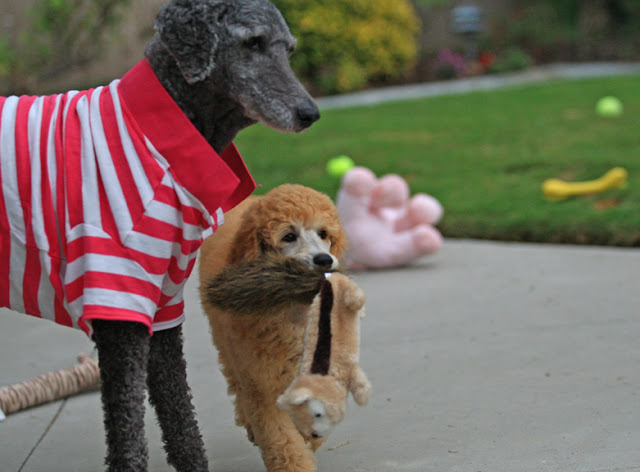
Imagine having your dog live to be a healthy happy 14.5 and maybe not make it through a surgery because of a growth.  No way was it coming off.  So I was sent home with cleanser and ointment and instructions.  It seemed to take forever for that bugger to heal, but it finally did.  Once it was healed it was in danger of catching on something; and when Elsa noticed it she was obsessed for a while so Tilley was put into a shirt to hide it.  That worked and Elsa got over it.

Lately I'd noticed that Milley was looking very dry, dead in fact.  So dead that I was sure I could break it in half at least.  You guessed it; this morning I decided to give it a go, just the tip.  It broke right off just like I thought; so later on in the day I got out my clippers and removed all the hair around it so that I could have a really good look.  It truly seemed to be attached by a thread so I worked with it for about a half hour.  By the end of the ordeal Tilley was left with the smallest tiny blip on her shoulder, the size of the point of a very sharp pencil, I'm not kidding.  I could not believe it; this thing had been there forever and all of a sudden dried up.

So I got out some cleanser and ointment and cleaned her all up.  I really cannot believe it; Milly the mole is now a thing of the past and what is left on her shoulder is not worthy of a name at all.  Weird.

Fear


Fear:  a distressing emotion aroused by impending danger, evil, pain, etc., whether the threat is real or imagined; the feeling or condition of being afraid.

Life can be filled with fear causing objects, situations or events.  How our canines deal with these depends on their past experiences, introduction and watching you.  Often there is a negative association to something; maybe a bad thing happened at the park so your dog is on guard while there.  Perhaps a large man wearing a hat scared your dog so now he is wary of hats and men.  Dealing with fear can be a very sensitive affair; how you undo fear takes time, patience and understanding.

Elements in our daily life can be fearful to dogs whether they are a new puppy or just experiencing for the first time.  Being that I have a new puppy I am dealing with lots of "new" things that Elsa has never seen before.  In fact almost everything she is experiencing is new.  She is very confident and assured; she has feared very few things so far but I'm sure there will be lots to overcome in the near future.  So far she has only been concerned with a little white Bichon, a bench, the birds in a pet store and a very loud siren at a strip mall.

So what do you do if your dog displays fearful behavior?  The first and most important thing is to never force; don't push, pull or cajole.  You need to outwardly ignore the fear, do not feed into it.  Next you need to display your own behavior of carefree and who cares attitude.  For Elsa's fear of the little white fluffy dog which initially surprised me; I simply bent down beside the dog and said hello.  She was bucking at the end of her leash trying to run away but as soon as she saw me saying "hi" she came to see what I was doing.  I was showing her that I was not afraid and that this guy was pretty darned cute.  Within a minute she was jumping on his head.

For the bench that she was afraid of I quietly sat down and put some cheerios on the edge.  Again within a minute she was sitting by my side not giving the bench another thought.  The birds that frightened her were loud and I knew they would be an issue.  So we went into the store and I just let her take it all in.  Her tail went down as she listened intently to the squawking.  After several minutes of letting her see that nothing was happening I asked her for a sit which is about as solid and reliable as it will ever be.  She looked up at me and sat; got her cheerio and we moved on, bird issue gone.

Your own behavior is huge; if you are a true "leader" for your dog then they will always look to you for guidance.  If there is a scary noise in my yard Elsa will look to my big dogs for guidance.  If they are just laying there then she will ignore the noise like they are.  If she is more afraid she will come and sit by me and watch what I am doing.  At that point I usually get up and putter around making it clear that the scary noise is not.

Remember, your dog is always watching you.


Fear


Fear:  a distressing emotion aroused by impending danger, evil, pain, etc., whether the threat is real or imagined; the feeling or condition of being afraid.

Life can be filled with fear causing objects, situations or events.  How our canines deal with these depends on their past experiences, introduction and watching you.  Often there is a negative association to something; maybe a bad thing happened at the park so your dog is on guard while there.  Perhaps a large man wearing a hat scared your dog so now he is wary of hats and men.  Dealing with fear can be a very sensitive affair; how you undo fear takes time, patience and understanding.

Elements in our daily life can be fearful to dogs whether they are a new puppy or just experiencing for the first time.  Being that I have a new puppy I am dealing with lots of "new" things that Elsa has never seen before.  In fact almost everything she is experiencing is new.  She is very confident and assured; she has feared very few things so far but I'm sure there will be lots to overcome in the near future.  So far she has only been concerned with a little white Bichon, a bench, the birds in a pet store and a very loud siren at a strip mall.  

So what do you do if your dog displays fearful behavior?  The first and most important thing is to never force; don't push, pull or cajole.  You need to outwardly ignore the fear, do not feed into it.  Next you need to display your own behavior of carefree and who cares attitude.  For Elsa's fear of the little white fluffy dog which initially surprised me; I simply bent down beside the dog and said hello.  She was bucking at the end of her leash trying to run away but as soon as she saw me saying "hi" she came to see what I was doing.  I was showing her that I was not afraid and that this guy was pretty darned cute.  Within a minute she was jumping on his head.

For the bench that she was afraid of I quietly sat down and put some cheerios on the edge.  Again within a minute she was sitting by my side not giving the bench another thought.  The birds that frightened her were loud and I knew they would be an issue.  So we went into the store and I just let her take it all in.  Her tail went down as she listened intently to the squawking.  After several minutes of letting her see that nothing was happening I asked her for a sit which is about as solid and reliable as it will ever be.  She looked up at me and sat; got her cheerio and we moved on, bird issue gone.

Your own behavior is huge; if you are a true "leader" for your dog then they will always look to you for guidance.  If there is a scary noise in my yard Elsa will look to my big dogs for guidance.  If they are just laying there then she will ignore the noise like they are.  If she is more afraid she will come and sit by me and watch what I am doing.  At that point I usually get up and putter around making it clear that the scary noise is not.

Remember, your dog is always watching you.


a distressing emotion aroused by impending danger, evil,pain, etc., whether the threat is real or imagined; the feelingor condition of being afraid. 

Asking a lot


This morning I was thinking about what we ask of our dogs.  We ask that they please forget about many of their dog ways and fit in; fit in to our human world that is.  Having a new puppy I am working on that right now and it does leave me pondering.  Yes we do ask a lot from our canine partners but this life together was forged many many years ago leaving us with merged results; dogs live with humans.

Sadly many dogs don't live great lives; street dogs, dogs who once lived with humans and were abandoned and those born on the outskirts of living with humans, not truly wild yet not domesticated.  Life for our dogs offers huge variety from living in a bag or arm of a human not being allowed to ever truly be a dog to that of a working dog who's life may be closely knit with a human yet more closely resembling a life from the far past.


When you add a dog to your life, adjustment can take a good long while and be a challenge.    Depending on the dog and yourself will factor in on how much you have to ask of your dog.  Just imagine the dogs who will live in wide open spaces; tending flocks of sheep and left pretty much to their own vs. dogs who live in the center of a big city in an apartment.  Sure the dogs out in the fields have a less confined life but there is more asked of them with regards to working for a human.  Dogs who live a more rural life are asked to curb their canine behaviors more to fit in.

Often a dog is chosen for a specific purpose; their very canine traits a plus.  Other times an owner may try to discourage those very traits; requiring a dog to work hard and asking much more of them.  Sitting back and considering where dogs come from and how far they have come as far as their life with us, humans can be a little amazing.  They often not only live with us but many work for us and depending on the work that they perform can be asking a lot or a little of them.


Dogs are great at being dogs; the vast majority of them that is.  A dogs ability to meld to our ways; assimilating into a human world is pretty amazing when you think about it.
 

Fall


Fall is upon us and in many places it sure looks like it.  But here in SoCal it is still green, still warm and sunny.  But in all the places where it is actually fall like it is time to start growing coat or making arrangements to get a coat for your otherwise shaved dog.  Dogs who have their own naturally beautiful coat are just fine as the temperatures drop; it grows in fuller, filling in any spots that might get cold.  But what about those who want to have a shaved dog because of "shedding" issues or have a dog that has less than a warm coat?

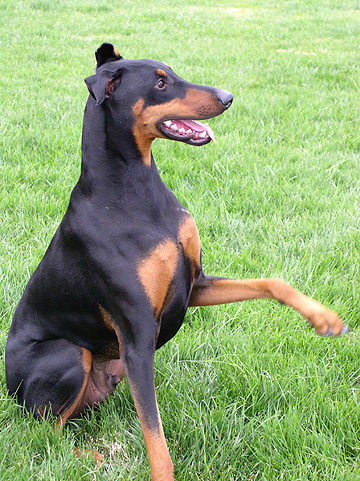
Many types of dogs like Italian Greyhounds, Great Danes, Greyhounds, Dachshunds or Dobermans have very thin coats and they need to be kept warm if they are going to be spending any length of time in the cold.  I've written often about how I am not into clothing for dogs as a fashion statement unless of course it is for a purpose like warmth.  Then I am all about keeping your dog nice and snuggly in some snazzy clothing.

Tilley often wears clothing, being that she is very old she has a difficult time cooling herself.  So we keep her nice and short which helps but also ensures that she stays fairly clean.  In the cooler evenings she can get cold so she has several coats that do the job nicely.  I tend to keep Luke with a longer coat as the weather gets cooler and the new little lady will get the same.  Jessie has a very thick and dense coat even though she is smooth coated so she goes au natural.  Also she hates wearing clothes.

I often see people with those naked type breeds; the ones with the very thin single smooth coat out in the cold.  Imagine if someone tossed you outside in the cold with no clothes on.  What should also be taken into consideration is the amount of time that a dog spends outdoors.  If they are indoors for most of the time except for a quick romp or elimination trip outside then they will feel the cold much more than a dog who spends more time outdoors.

As you pull out the sweaters; long johns and wool socks, consider your dog and their ability to keep themselves warm outdoors.  You may need nothing at all but a good brush; but perhaps you need to find a dapper new coat to keep them warm this fall and winter.